Industrial Land Zoning in Malaysia: What Buyers Must Verify Before Signing
Learn how title conditions, local-plan zoning and planning permission affect whether an industrial project can lawfully proceed.
The short answer: a title that appears to permit industrial use does not, by itself, confirm that a proposed factory, warehouse, logistics hub or data-centre development can proceed. A buyer should separately verify the registered title conditions, the gazetted local-plan zoning, the applicable planning permission and the approvals for the actual building and business activity.
For industrial-property decisions in Peninsular Malaysia, these layers interact but perform different legal and practical functions. Under section 18 of the Town and Country Planning Act 1976, land and buildings generally must be used in conformity with the local plan. Section 19 generally prohibits development without planning permission. The local planning authority considers the development plan and may approve an application with conditions or refuse it. (Attorney General’s Chambers, Act 172)
That is why “the grant says industrial” should be the start of due diligence—not the end.
This article focuses on the planning framework commonly applied in Peninsular Malaysia. The Federal Territories, Sabah and Sarawak may operate under different planning and land laws. Requirements also vary by state, local authority, site and proposed operation. Obtain written confirmation from the relevant authorities and qualified advisers.
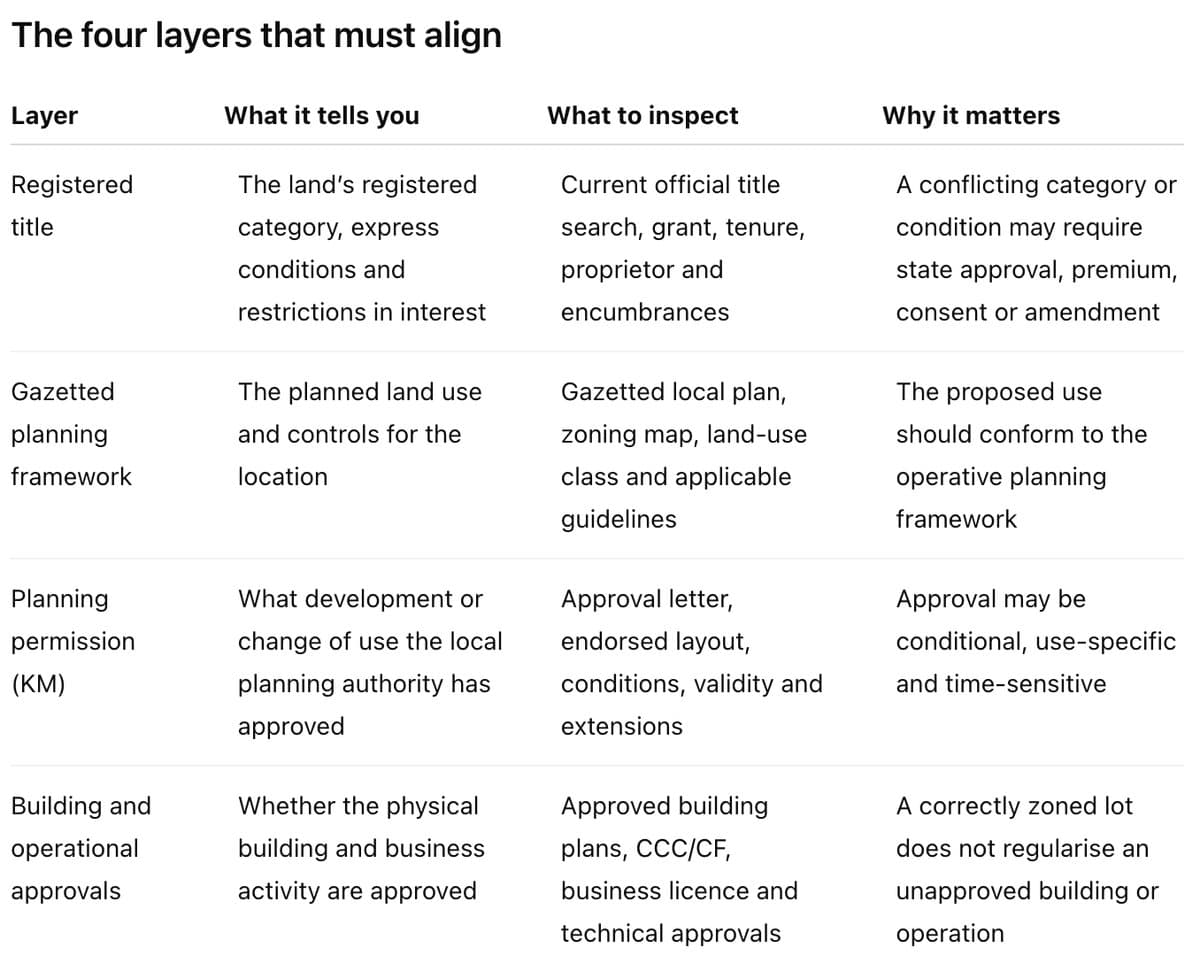
The four layers that must align
The Federal Department of Director General of Lands and Mines lists the National Land Code 1965 as the principal federal land legislation for Peninsular Malaysia. State procedures are then relevant to applications affecting title conditions. For example, Selangor’s official land-rule form provides for applications to alter or impose a land-use category, express condition or restriction in interest under section 124 of the
Code. (JKPTG land legislation portal; Selangor Land Rules application form)
Title category is not the same as planning zoning
A registered title and a local plan answer different questions.
The title records the land interest and the conditions attached to it. The local plan guides and controls how land within the planning area may be used and developed. A site can therefore create risk when the title, the local-plan zoning and the proposed operation do not match.
Common examples include:
· a title condition that is broader or narrower than the buyer’s intended use;
· land shown for industrial use, but the proposed process is not allowed under the relevant use class or planning guidelines;
· an existing warehouse being converted to manufacturing without confirmation of change-of-use requirements;
· a “light industrial” project being marketed for an activity with heavier traffic, emissions, storage or hazard characteristics;
· a data-centre proposal that is industrial in concept but still depends on planning, utility, building and technical approvals.
PLANMalaysia’s I-Plan portal can assist with preliminary land-use and zoning reference. However, PLANMalaysia expressly states that its online information is for general reference and should be verified with the state PLANMalaysia office or local authority; gazetted plans and current official guidelines prevail if there is a conflict. (PLANMalaysia I-Plan)
Practical rule: use an online map to screen a site, but use the gazetted document and written authority verification to make a transaction decision.
What planning permission actually confirms
Kebenaran Merancang, commonly called KM, is planning permission for a development. It should not be treated as a one-line confirmation that “the land is industrial.”
Under Act 172:
· section 19 generally requires planning permission before development;
· section 22 requires the local planning authority to consider the development plan and other planning matters;
· planning permission may be granted subject to conditions or refused;
· section 24 provides that planning permission may lapse if development does not commence within the prescribed period, unless an exception or valid extension applies.
Accordingly, buyers should inspect the complete approval pack, not only the cover letter. The endorsed plans, conditions, permitted activity, density or plot ratio, access arrangement, infrastructure obligations and validity period can materially affect the site’s value and development programme.
The KPKT OSC 3 Plus document checklist also shows that a planning application may require the title, official land search, location and planning plans, a development proposal report, survey information and—depending on the application—technical documents concerning drainage, electricity, sewerage, water, traffic, geology or environmental approval. (KPKT OSC 3 Plus planning-permission checklist)
Seven checks before signing an SPA, LOI or tenancy
1. Obtain a current official title search
Confirm the registered proprietor, tenure, land-use category, express conditions, restrictions in interest, caveats, charges and the exact lot details. Do not rely only on a marketing brochure or an old copy of the grant.
2. Identify the correct planning authority
Confirm the local authority and planning area governing the lot. Boundaries and jurisdiction matter, particularly for large industrial parcels near municipal borders.
3. Verify the gazetted local plan
Check the operative local plan—not only a draft plan or a generic online layer. Record:
· zoning and permitted-use class;
· whether the proposed factory, warehouse or special use is permitted, conditional or prohibited;
· plot ratio, site coverage, setbacks and building-height controls where applicable;
· road, drainage, utility, buffer or reservation requirements;
· any proposed road widening, infrastructure corridor or public reservation affecting the parcel.
4. Match the proposed activity—not merely the word “industrial”
Describe the buyer’s actual operation in sufficient detail:
· manufacturing process and raw materials;
· storage type and quantity;
· machinery load and power demand;
· emissions, effluent, scheduled waste or hazardous materials;
· operating hours and workforce;
· heavy-vehicle movements;
· proposed building height, floor loading and ancillary uses.
An authority or consultant cannot give a meaningful suitability opinion if the intended operation is described only as “factory.”
5. Review the KM approval and endorsed plans
Check:
· approval reference and approving authority;
· approved use and development description;
· approved layout and access;
· conditions precedent and technical conditions;
· development charge or contribution obligations;
· commencement deadline, expiry and extensions;
· whether the current buildings and use match the approval.
6. Check whether title amendment or conversion is required
If the category or express condition does not support the proposal, investigate the relevant state-land procedure. Ask for an indicative view on premium, timing, authority discretion, consents from registered interest holders and the risk that approval may not be granted.
Never price the property as “conversion guaranteed” unless the relevant written approval has already been obtained and remains valid.
7. Protect the transaction contractually
Where approval is unresolved, consider conditions precedent drafted by Malaysian lawyers. Depending on the deal, these may address:
· satisfactory title, zoning and planning due diligence;
· written confirmation of the proposed use;
· land-use conversion or amendment of express conditions;
· valid planning and building approvals;
· financier approval;
· termination and refund rights if a critical approval fails;
· responsibility for premium, contributions and professional fees.
Red flags that require further investigation
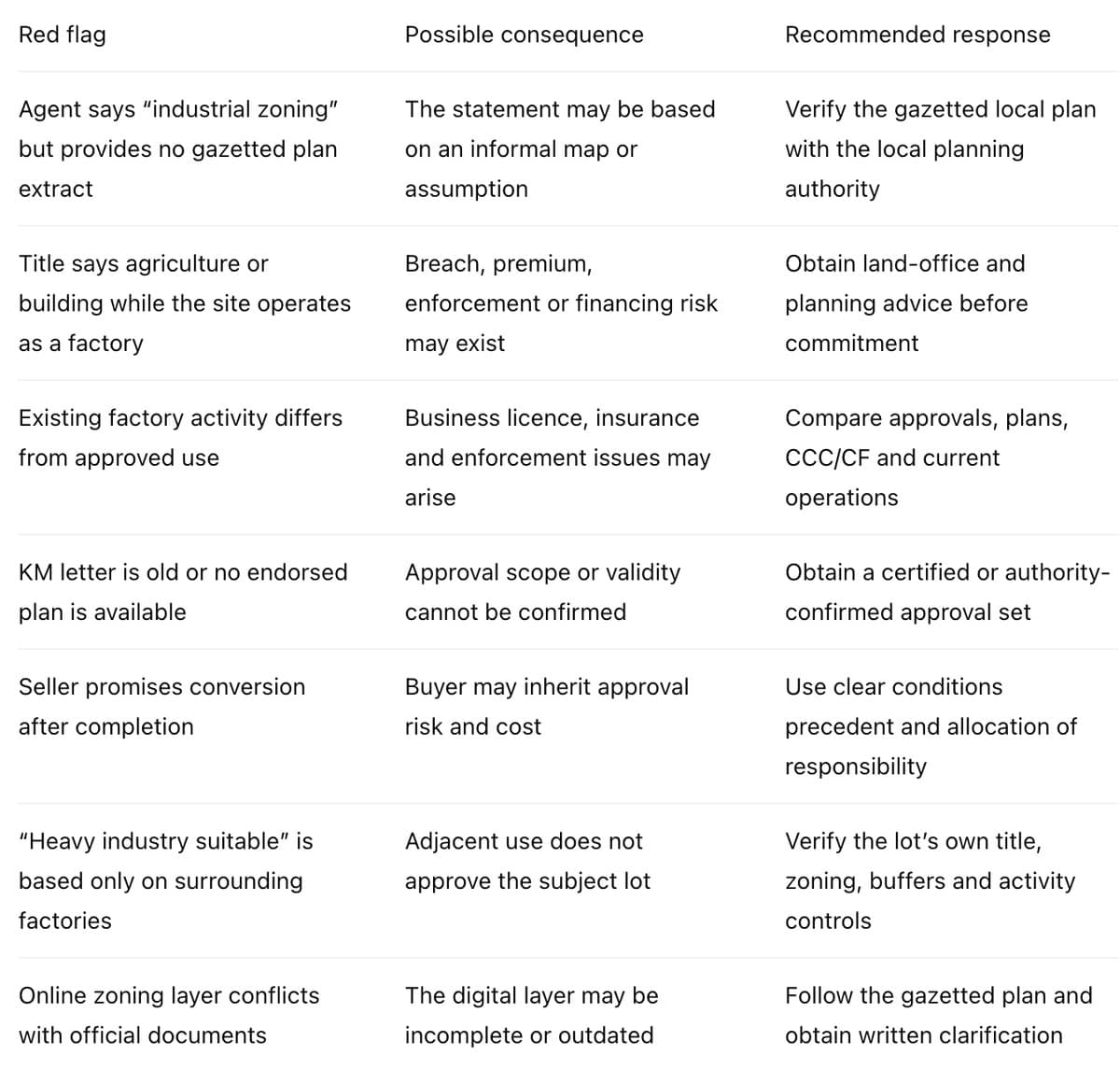
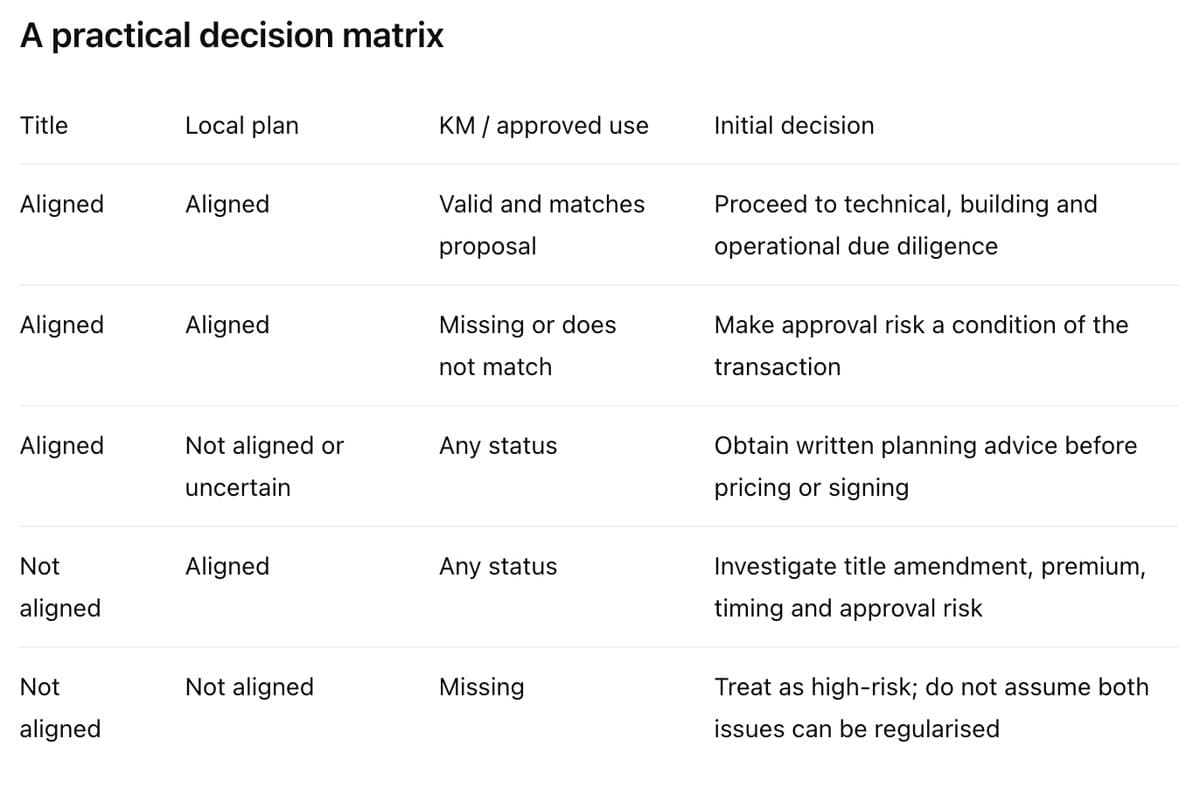
This matrix is a screening tool, not an approval. A technically suitable industrial site can still fail because of access, drainage, power, water, sewerage, environmental constraints, building compliance or an activity-specific licence.
Who should verify the site?
Industrial due diligence is multidisciplinary. Depending on the transaction, the buyer may need:
· a conveyancing lawyer for title, SPA and conditions precedent;
· a registered town planner for zoning, use class and KM strategy;
· a land surveyor for boundaries and survey information;
· an architect and professional engineers for building and infrastructure;
· environmental and fire consultants where relevant;
· the local planning authority, land office and technical agencies for written confirmation;
· the financier and insurer for bankability and coverage requirements.
The best time to coordinate these checks is before the deposit becomes non-refundable or before the tenant commits to expensive machinery and fit-out.
Frequently asked questions
If the title says “industrial,” can I build any type of factory?No. The proposal must also comply with the operative planning framework, obtain the necessary planning and building approvals, and meet requirements applicable to the specific activity. “Industrial” is not automatic approval for every process, scale or hazard category.
Is an online zoning map enough for due diligence?No. Online tools are useful for preliminary screening. PLANMalaysia advises users to verify information with the relevant state office or local authority, and states that gazetted plans and current official guidelines prevail.
What is the difference between zoning and Kebenaran Merancang?Zoning is the planning designation and control framework for an area. Kebenaran Merancang is the planning permission granted for a particular development or change of use, normally with approved plans and conditions.
Can a buyer apply to change the title condition?An application may be possible under the relevant land law and state procedure, but approval is discretionary and may involve premium, fees, consents, conditions and time. The transaction should not assume success before written approval.
Does an existing factory prove that the use is legal?Not necessarily. Buyers should compare the current use and structures against the title, gazetted plan, KM approval, approved building plans, CCC/CF, business licence and any activity-specific approvals.
Does KM remain valid forever?Not always. Section 24 of Act 172 provides for planning permission to lapse in certain circumstances if development does not commence within the required period, subject to exceptions and valid extensions. Verify the approval date, commencement evidence and extension documents.
What should an industrial tenant check?A tenant should confirm that its exact operation is permitted, the building and alterations are approved, the property can support its utilities and machinery, and the lease allocates responsibility for approvals, reinstatement and authority requirements.
Final takeaway
For an industrial-property decision in Malaysia, do not ask only, “Is this industrial land?”
Ask four separate questions:
1. What does the registered title permit and restrict?
2. What does the gazetted local plan allow at this lot?
3. What development and use has the local authority approved?
4. Do the building and operational approvals match the buyer’s actual activity?
When all four layers align—and the technical infrastructure is also suitable—the buyer, tenant, financier and developer can make a more defensible decision. When they do not align, the gap should be priced, documented and resolved before commitment.
This article provides general information and is not legal, planning, engineering or regulatory advice. Requirements vary by jurisdiction, proposal and authority. Obtain current written verification and professional advice for the specific property.
Official references for publication1. Attorney General’s Chambers — Town and Country Planning Act 1976 (Act 172)
2. JKPTG — Federal land legislation portal
3. PLANMalaysia — I-Plan land-use and zoning portal
4. KPKT — OSC 3 Plus planning-permission checklist
5. Selangor Government — application to alter or impose title category, express condition or restriction