A practical due-diligence guide to EIA, emissions, industrial effluent, scheduled waste and contaminated-land risks.
Before buying, leasing or developing a factory in Malaysia, confirm whether the proposed industrial activity requires an Environmental Impact Assessment (EIA), whether existing pollution-control systems and notifications match that activity, how industrial effluent and scheduled waste are managed, and whether past operations may have contaminated the land or groundwater. A property’s industrial title, planning approval or Certificate of Completion and Compliance does not by itself establish environmental compliance.
The correct question is not simply, “Does this factory have DOE approval?” Environmental obligations are divided across the project, the premises, the process, the equipment, the discharge and the operator. Buyers and tenants should therefore compare the property’s environmental record with their own proposed process before the deposit, sale agreement or tenancy becomes unconditional.
Answer first: A Malaysian factory buyer or tenant should request the EIA and approval conditions where applicable; DOE correspondence and inspection history; air-emission and industrial-effluent notifications; pollution-control design, monitoring and maintenance records; scheduled-waste inventories and consignment records; and any soil or groundwater assessment. These documents must then be tested against the incoming occupier’s actual activity, capacity, raw materials, emissions, wastewater and waste codes.
This guide uses “DOE” to refer to Malaysia’s Department of Environment, also known as Jabatan Alam Sekitar (JAS).
Why environmental due diligence affects the property decision
Environmental risk can change a factory’s fit-out cost, occupation timeline, operating capacity, financing, insurance and resale value. It may also determine whether the buyer’s intended production process can operate at the site without new systems, studies, notifications or approvals.
Common commercial consequences include:
l capital expenditure for an air-pollution control system or industrial effluent treatment system;
l delays while an EIA, Environmental Management Plan or technical submission is prepared;
l limits on production capacity, operating hours, fuel, discharge or storage;
l removal or remediation of contaminated soil, tanks, drains or groundwater;
l interruption while an existing system is repaired or upgraded;
l uncertainty over whether an earlier approval remains relevant to a new process or operator;
l lender, insurer or customer ESG concerns; and
l contractual disputes over who must correct legacy non-compliance.
Environmental due diligence should therefore begin while properties are being shortlisted, not after machinery has been ordered.
Five environmental layers to check
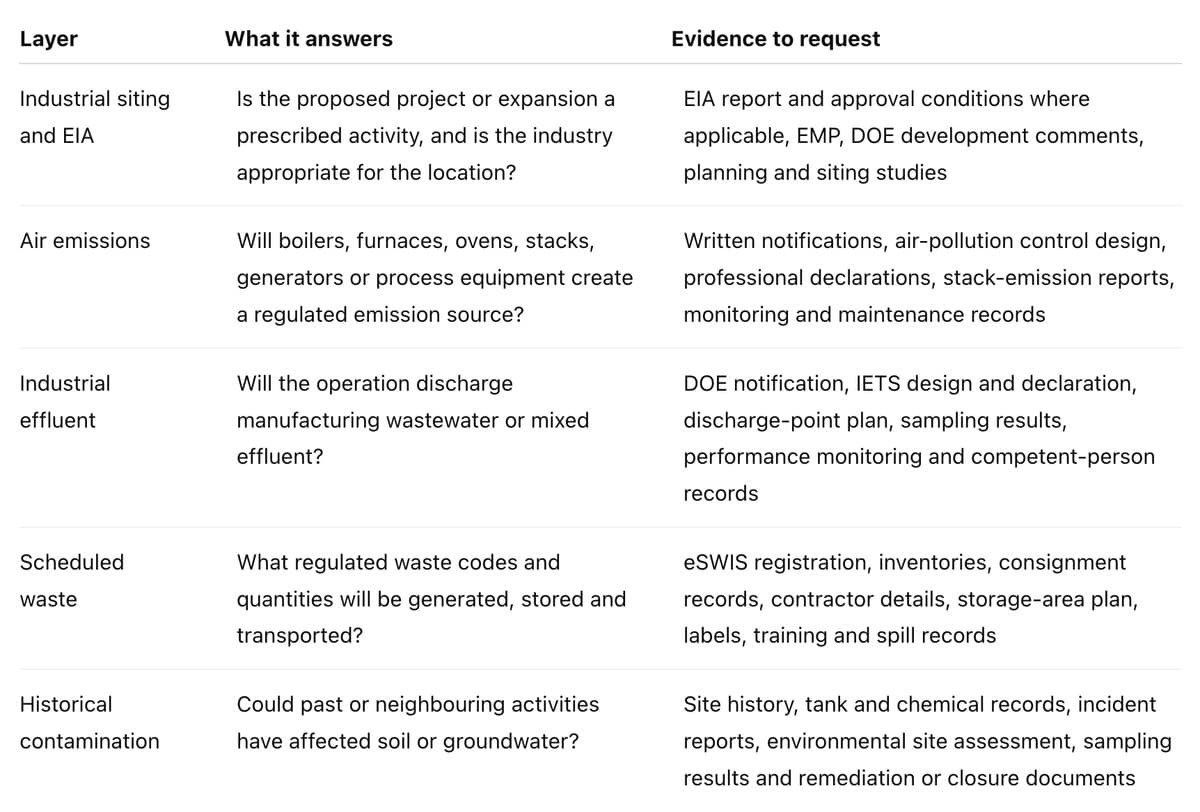
The absence of one document does not automatically prove a breach, because the applicable requirements depend on the activity and site. It is, however, a reason to obtain a written assessment from the appropriate environmental professional and authority.
1. Determine whether an EIA is required
Malaysia’s DOE states that an EIA is required when a proposed project falls within the Environmental Quality (Prescribed Activities) (Environmental Impact Assessment) Order 2015. The Order separates prescribed activities into a First Schedule and a Second Schedule; Second Schedule projects require public display and public comment. It also addresses projects that are divided into smaller components and expansions that cause an activity to reach a prescribed threshold.
An EIA is not required for every factory. The answer depends on the nature, scale and location of the proposed project. The full list and thresholds must be checked rather than inferred from the word “industrial.”
DOE also makes an important distinction: approval of an EIA report is not the same as project approval. The project still requires approval from the relevant state, local and technical authorities. See the DOE EIA Frequently Asked Questions and the official Environmental Quality (Prescribed Activities) (Environmental Impact Assessment) Order 2015.
For a property transaction, check:
1. whether the original development or current activity was a prescribed activity;
2. whether the buyer’s expansion, new production line or increased capacity could cross a threshold;
3. whether the approval conditions match the actual development and operation;
4. whether required mitigation, monitoring, audit or reporting has been performed; and
5. whether the proposed project differs materially from the project assessed in the EIA.
EIA reports and Environmental Management Plans must be prepared by consultants registered with DOE through the Malaysian Certified Environmental Practitioner framework where those documents are required.
2. Apply the current industrial-siting guidance
On 23 January 2026, DOE announced that the Guidelines on Pollution Prevention in Industrial Siting 2025 (PPIS) took immediate effect and replaced the Environmental Essentials for Siting of Industries in Malaysia 2017. DOE instructed EIA consultants to use PPIS for development input and EIA studies at both the terms-of-reference and report stages.
This matters when buyers compare a technically attractive site against neighbouring uses, environmental receptors and pollution-prevention requirements. The correct buffer, control and siting analysis depends on the proposed industry and the current guideline—not on an old marketing description of the industrial park. See DOE’s official implementation notice dated 23 January 2026.
Ask the environmental consultant to confirm which current siting guideline applies and whether the proposed process is compatible with the location.
3. Verify air-emission sources and control systems
Factories may create air emissions through combustion or production equipment such as boilers, furnaces, ovens, dryers, stacks, extraction systems and certain standby generators.
Under the Environmental Quality (Clean Air) Regulations 2014, an owner or occupier must provide written notification to the Director General at least 30 days before specified work that may create a new emission source or materially change an existing emission source or air-pollution control system. The Regulations also contain requirements concerning control systems, professional engineering, competent supervision, performance monitoring and emission monitoring.
Review the official Environmental Quality (Clean Air) Regulations 2014.
During due diligence, do not check only whether a stack exists. Compare:
- the notified equipment and process against what is installed;
- the approved or declared control-system design against the as-built arrangement;
- fuel type, capacity and operating load;
- stack location and sampling access;
- monitoring reports and exceedances;
- maintenance, breakdown and accidental-emission records;
- competent-person arrangements; and
- proposed changes under the incoming occupier.
A control system designed for the seller’s process may not be adequate for the buyer’s different raw material, temperature, throughput or emission profile.
4. Check industrial effluent and the treatment system
Manufacturing wastewater is not the same as ordinary domestic sewage. The Environmental Quality (Industrial Effluent) Regulations 2009 apply to premises that discharge industrial effluent or mixed effluent onto land or into inland or Malaysian waters, subject to the exclusions in the Regulations.
The Regulations cover notification, design and construction of an industrial effluent treatment system (IETS), monitoring, operation, competent persons and acceptable discharge conditions.
They distinguish Standard A and Standard B limits according to the receiving waters and catchment context. See the official Environmental Quality (Industrial Effluent) Regulations 2009.
Request and verify:
- the manufacturing process flow and water balance;
- the source and estimated volume of each wastewater stream;
- the notified discharge point and receiving environment;
- IETS design documents and professional declarations;
- as-built layout, tanks, bunds, piping and sampling points;
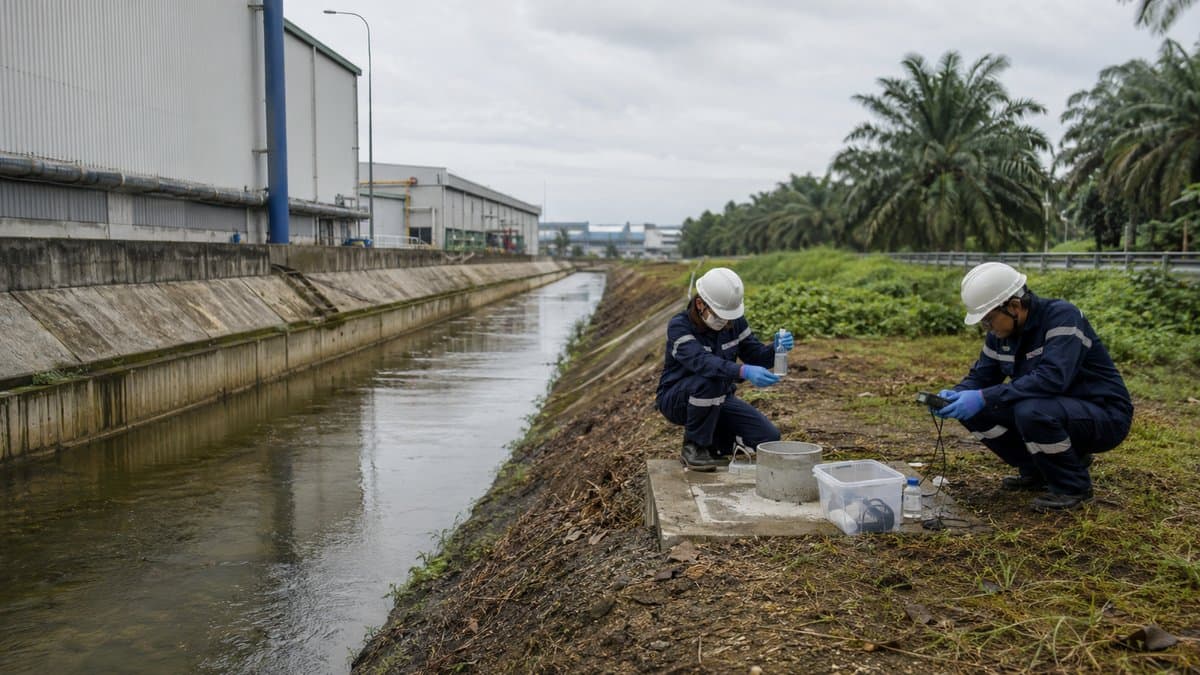
- recent laboratory results and monitoring records;
- sludge handling and disposal records;
- breakdown, bypass, overflow or complaint history; and
- the capacity available for the buyer’s proposed production volume.
Inspect the drainage system carefully. Stormwater drains should not be assumed to be lawful process-effluent discharge routes, and concealed cross-connections can create both compliance and operational risk.
5. Review scheduled-waste records and storage
The Environmental Quality (Scheduled Wastes) Regulations 2005 regulate listed waste streams and impose responsibilities on waste generators. They address notification, storage, labelling, inventory, transport information, spills and training.
The Regulations generally allow scheduled waste to be stored for up to 180 days after generation, provided the accumulated quantity does not exceed 20 metric tonnes, unless written approval permits otherwise. Storage containers must be compatible and able to prevent leakage; incompatible wastes require separation and separate secondary containment. Generators must also maintain an accurate and up-to-date inventory.
DOE’s eSWIS portal is used by scheduled-waste generators and receiving premises to record inventory and consignments. The detailed legal requirements are in the official Environmental
Quality (Scheduled Wastes) Regulations 2005.
For a factory purchase or tenancy, check:
- which scheduled-waste codes arise from the existing and proposed process;
- monthly generation quantities and peak inventory;
- eSWIS inventory and consignment history;
- whether receivers and transporters are appropriate for the waste;
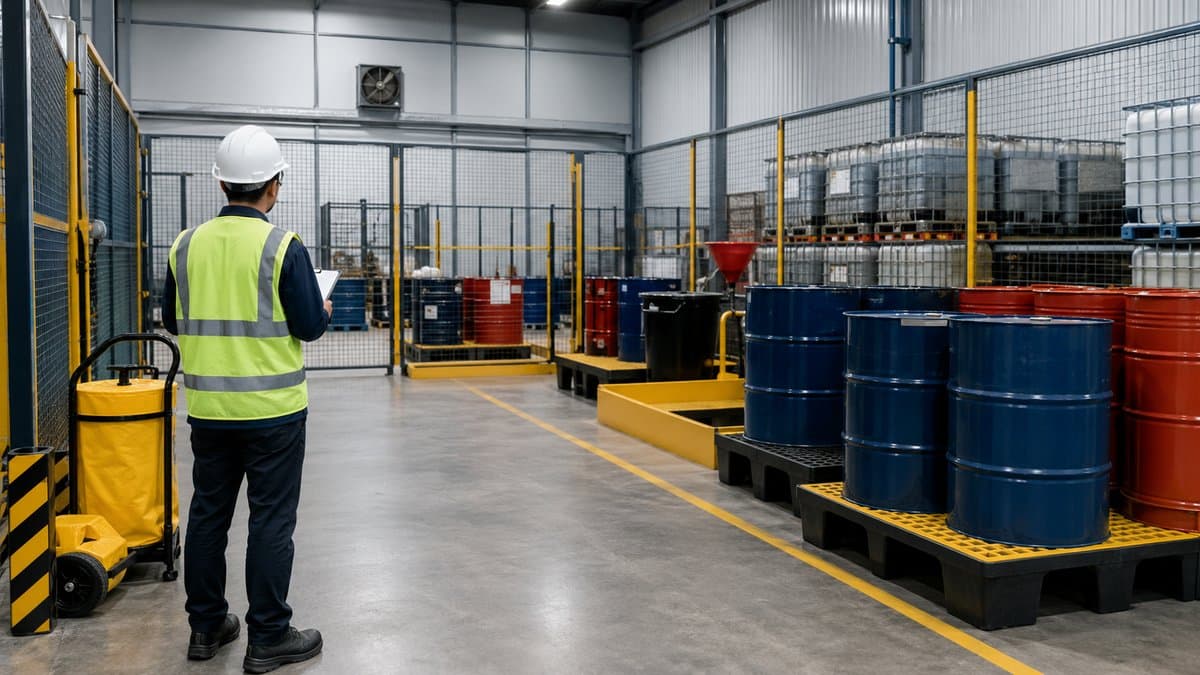
- storage duration, capacity, bunding, segregation and security;
- whether containers are closed, compatible and properly managed;
- spill response, training and incident records; and
- abandoned drums, buried material or unidentified chemicals left on site.
The incoming occupier should create its own compliance plan. It should not assume that the previous operator’s registration, contractors or waste classification automatically solves its obligations.
6. Investigate historical soil and groundwater contaminationA clean-looking factory can still carry subsurface risk. Past chemical handling, leaking tanks, transformers, metal treatment, battery operations, waste storage, workshops or neighbouring activities may have affected soil or groundwater without obvious surface evidence.
DOE’s Contaminated Land Management and Control Guidelines provide a national framework for screening, assessment and remediation. The guidelines explain that potentially contaminating activity may occur both on the property and at neighbouring land, and that screening levels indicate when further assessment may be needed. See DOE’s Malaysian Recommended Site
Screening Levels for Contaminated Land.
Use a risk-based sequence:
1. review historical land use, occupiers, processes and site plans;
2. inspect chemical stores, tanks, transformers, pits, drains and visibly stained areas;
3. check incident, spill, complaint and enforcement records;
4. review neighbouring land uses and groundwater direction where relevant;
5. appoint a qualified environmental professional for a site assessment; and
6. undertake targeted soil or groundwater sampling when the evidence supports it.
Sampling should be designed and interpreted by qualified professionals. A random laboratory test without a defensible sampling plan may create false comfort.
Documents to request before committing
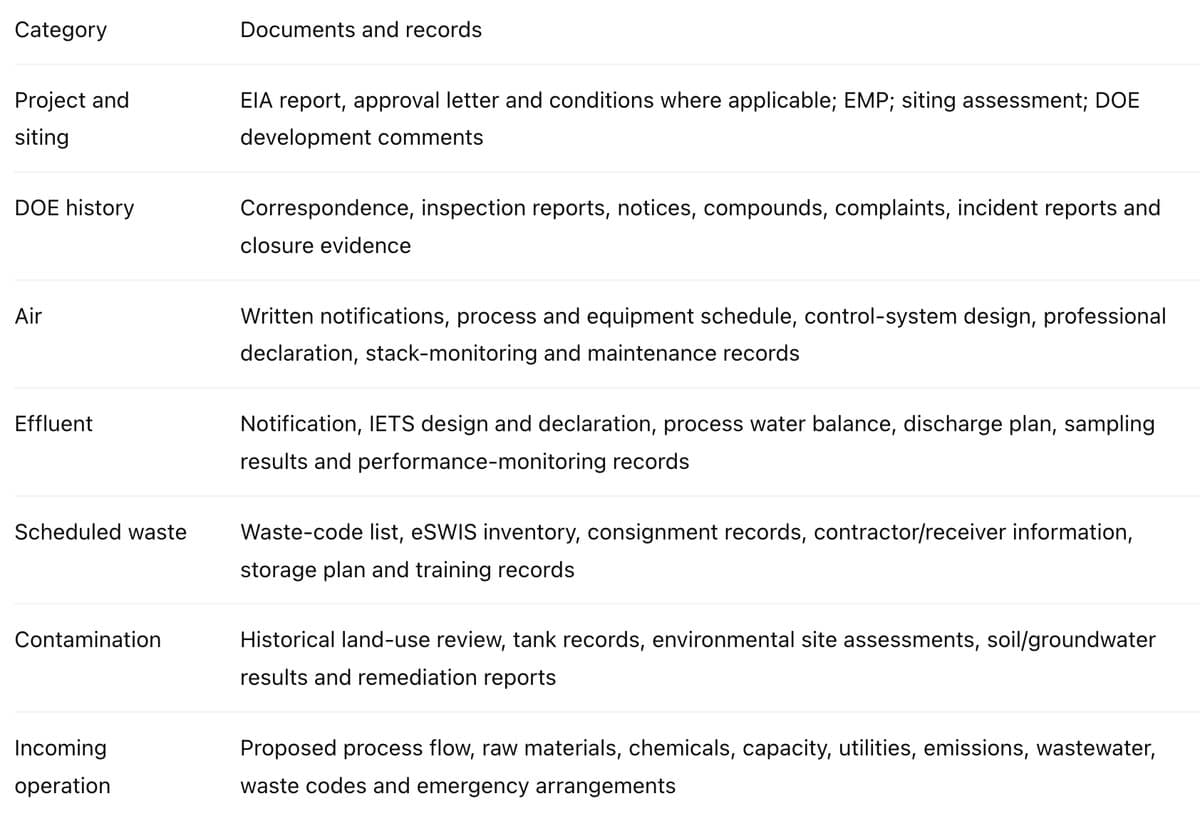
Request records for a meaningful period rather than only the latest month. Where records are incomplete, ask the relevant professionals to define what can be independently verified and what remains an assumption.
Site-inspection red flags
Pause and investigate when you find:
- unexplained drums, tanks, sludge, staining or chemical odours;
- process wastewater entering a stormwater drain;
- disconnected, bypassed or undersized treatment equipment;
- a stack or production line that does not appear in the available submission records;
- inconsistent waste quantities across inventory and consignment records;
- long-stored containers, corroded drums or missing secondary containment;
- filled pits, removed underground tanks or recently resurfaced areas with no history;
- neighbour complaints, repeated spills or enforcement correspondence;
- EIA or approval conditions that do not match the completed development; or
- a seller or landlord unwilling to provide environmental records or inspection access.
A red flag is not always a reason to reject the property. It is a reason to quantify the issue, identify responsibility and protect the transaction before commitment.
How buyers and tenants can protect the deal
The contractual approach depends on the property and advice from Malaysian lawyers and environmental professionals. Possible protections may include:
- a defined environmental due-diligence period;
- access for document review, inspection and sampling;
- disclosure of past activities, tanks, spills, notices and scheduled waste;
- representations concerning specified environmental records;
- seller or landlord removal of chemicals and waste before handover;
- conditions precedent for critical written confirmation or approval;
- allocation of legacy contamination and remediation responsibility;
- cost, retention, indemnity or termination mechanisms where appropriate; and
- a fit-out period that reflects the time needed for new systems and submissions.
Do not rely on a broad statement that the premises are “DOE approved.” List the documents and conditions that matter to the buyer’s actual operation.
Who should conduct the review?
Industrial environmental due diligence may require:
- a DOE-registered EIA consultant where EIA or EMP work is involved;
- an environmental site assessor for contamination risk;
- professional engineers for air-pollution control or industrial effluent systems;
- competent persons for the relevant pollution-control systems;
- an environmental laboratory for properly designed sampling;
- a town planner, architect and engineers for site and building coordination;
- a Malaysian lawyer for transaction documents and liability allocation; and
- direct written clarification from DOE and other relevant authorities.
The property adviser can coordinate information, but regulatory suitability must be verified by the relevant authority and qualified professionals.
Frequently asked questions
Does an industrial title mean the factory can operate any manufacturing process?No. The title is only one layer. The process must also align with planning, building, environmental, safety and activity-specific requirements. Its emissions, wastewater, waste and hazard profile may trigger additional controls.
Does every factory in Malaysia need an EIA?No. An EIA is required when the proposed project falls within the Environmental Quality (Prescribed Activities) (Environmental Impact Assessment) Order 2015 or another applicable jurisdictional requirement. Check the actual activity, scale and location.
Is EIA approval the same as project approval?No. DOE’s official FAQ states that DOE approves the EIA report; project approval is issued by the relevant approving authorities. Other planning, land, building and technical approvals may still be required.
Can a buyer rely on the previous operator’s DOE records?The records are important evidence, but they must be compared with the buyer’s proposed process, capacity, equipment and waste streams. Do not assume that a different operation or operator is automatically covered.
What scheduled-waste records should a factory buyer request?Request the waste-code list, eSWIS inventories, consignment records, contractor and receiver information, storage records, training records and spill history. Inspect the storage area and check whether waste remains at handover.
When should soil or groundwater testing be considered?Testing should be considered when site history, hazardous-material use, tanks, spills, staining, neighbouring activities or other evidence indicates contamination risk. A qualified environmental professional should design the assessment and sampling plan.
Who pays for environmental remediation after a transaction?That depends on the facts, applicable law, authority direction and transaction documents. Buyers and tenants should obtain legal and environmental advice and allocate legacy risk expressly before committing.
Final takeaway
A factory can be suitable in size, location, power and building design yet still be unsuitable for the intended manufacturing process because of environmental constraints.
Before buying or leasing, align five items:
1. the exact proposed activity and capacity;
2. the applicable EIA and industrial-siting requirements;
3. the air and effluent control systems;
4. scheduled-waste management; and
5. the site’s contamination history.
When the property record and incoming operation are reviewed together, decision-makers can price the real compliance work, plan a more realistic occupation timeline and avoid inheriting an unidentified environmental problem.
Explore industrial properties for sale and rent in Malaysia on XPillar, then request the environmental documents needed to verify each shortlisted property independently.
Important note: This article provides general industrial-property information and is not legal, environmental, engineering or regulatory advice. Requirements differ by activity, scale, location, jurisdiction and authority. Sabah and Sarawak also have state environmental frameworks for specified activities. Obtain current written confirmation and professional advice for the specific project and property.
Official references
Department of Environment Malaysia — Environmental Quality Act 1974 (Act 127)
1. Department of Environment Malaysia — Environmental Quality Act 1974 (Act 127)
2. DOE — Frequently Asked Questions: Environmental Impact Assessment
3. Environmental Quality (Prescribed Activities) (Environmental Impact Assessment) Order 2015
4. DOE — Implementation of Guidelines on Pollution Prevention in Industrial Siting 2025, notice dated 23 January 2026
5. Environmental Quality (Clean Air) Regulations 2014
6. Environmental Quality (Industrial Effluent) Regulations 2009
7. Environmental Quality (Scheduled Wastes) Regulations 2005
8. DOE — Electronic Scheduled Waste Information System (eSWIS)
9. DOE — Malaysian Recommended Site Screening Levels for Contaminated Land
article:
Anchor: industrial land zoning in Malaysia
URL: https://www.xpillar.com/news/industrial-land-zoning-in-malaysia-what-buyers-must-verify-before-signing
Anchor: factory CCC and approved building plans
URL: https://www.xpillar.com/news/factory-ccc-and-approved-building-plan-checks-in-malaysia
Anchor: industrial property flood and drainage due diligence
URL: https://www.xpillar.com/news/industrial-property-flood-and-drainage-due-diligence-in-malaysia-what-buyers-and-tenants-must-check
Anchor: factory power supply in Malaysia
URL: https://www.xpillar.com/news/factory-power-supply-in-malaysia-what-buyers-must-verify-before-buying-or-renting
Anchor: industrial properties for sale and rent in Malaysia
URL: https://www.xpillar.com/properties/industrial