
Is Your Industrial Land Suitable for a Data Centre in Malaysia? How Developers Check Land Size and TNB Power
你的马来西亚工业地适合建设数据中心吗?开发商如何评估土地面积与TNB电力
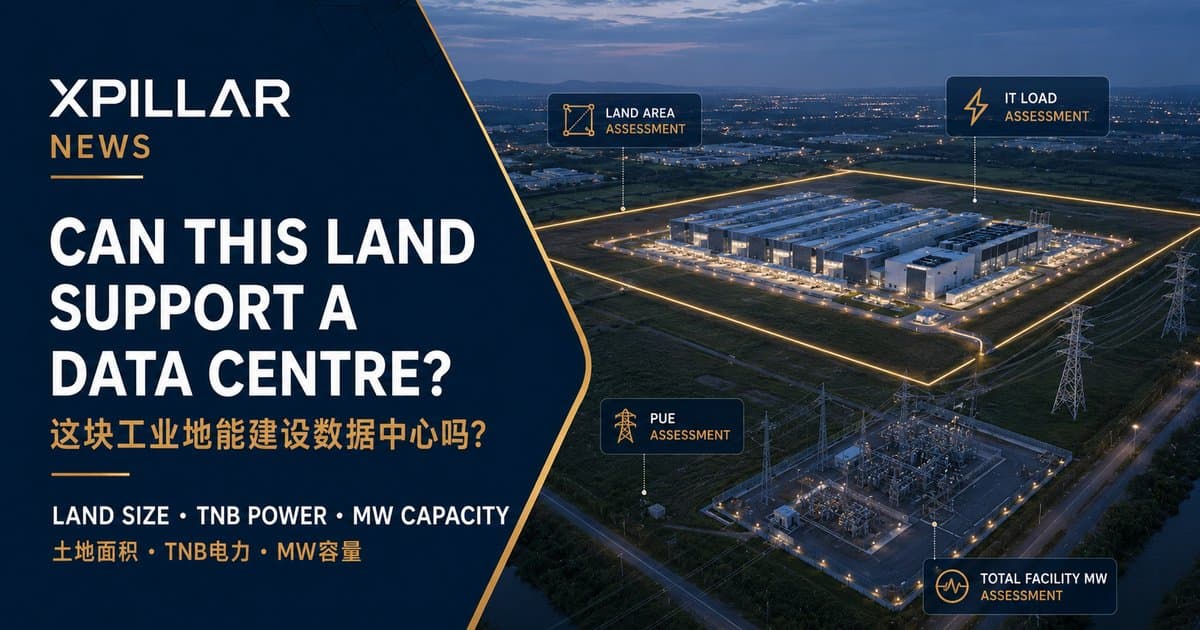
Malaysia’s data centre market has created a new question for industrial landowners: if TNB medium-voltage power is nearby, how many megawatts can the land support—and how large must the site be?
马来西亚数据中心市场快速发展后,越来越多工业地主开始问:如果土地附近有TNB中压(MV)电力,这块地可支持多少MW的数据中心,又需要多少亩或英亩土地?
There is no reliable answer based on acreage or voltage alone. A 20-acre site near a 33kV line is not automatically a 20MW data centre site. Likewise, a larger parcel may be commercially unsuitable if no firm capacity, acceptable connection route, diverse fibre, planning pathway or cooling solution is available.
单凭土地面积或电压等级,无法得出可靠答案。20英亩土地旁边有33kV电缆,并不代表它自动成为20MW数据中心用地;面积更大的土地,如果没有可确认的电力容量、合理的接电路线、多路径光纤、规划条件或冷却方案,也可能不符合开发商要求。
For data centre developers, the correct sequence is:
对于数据中心开发商,正确评估顺序是:
- define the target IT capacity; 确定目标IT负载;
- convert IT capacity into total facility electricity demand; 把IT负载换算成整座设施的用电需求;
- obtain a formal power feasibility response for the precise site and required date; 针对准确地块和目标通电日期取得正式电力可行性答复;
- test whether the land can accommodate the buildings and all supporting infrastructure; and 检查土地能否容纳建筑物和全部配套设施;以及
- verify planning, environmental, water, telecoms, access and delivery risks. 核实规划、环境、水源、光纤、道路及施工风险。
This guide gives landowners, agents and investors a practical first-screening method. It is not a substitute for TNB’s written assessment, a competent electrical engineer’s design or approval by the relevant authorities.
本文提供地主、代理和投资者可使用的初步筛选方法,但不能代替TNB书面评估、合格电气工程师设计及主管机关批准。
First: do not confuse IT load, facility load and TNB maximum demand
首先分清IT负载、设施总负载与TNB最大需量
Data centre capacity is often advertised in “MW”, but that figure may refer to different things.
市场常用“MW”介绍数据中心容量,但它可能代表不同概念。
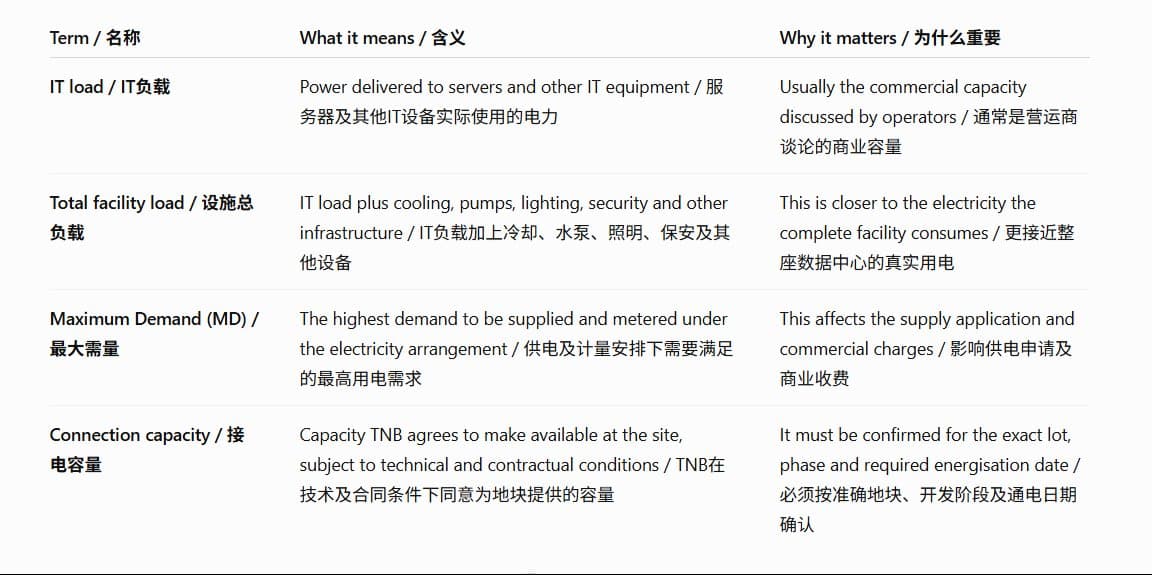
The standard relationship is:
基本换算关系是:
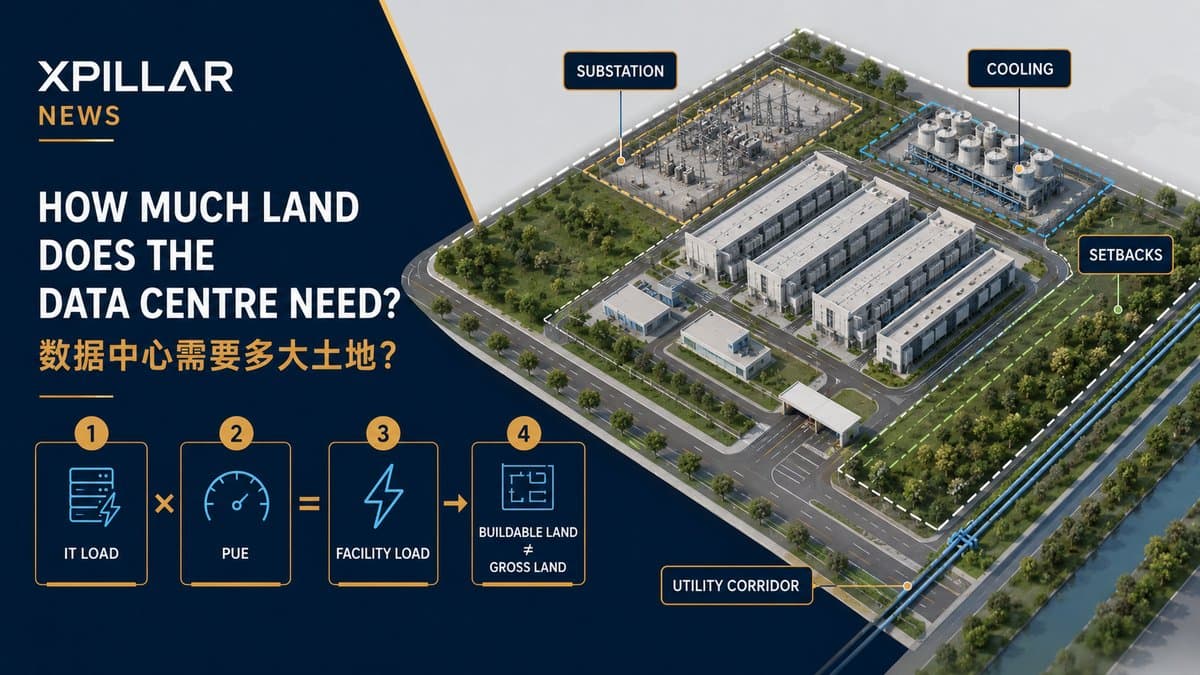
Total facility demand = IT load × PUE
设施总负载 = IT负载 × PUE
PUE, or Power Usage Effectiveness, is total data centre energy divided by IT-equipment energy. Malaysia’s sustainable data centre guideline uses PUE as a core efficiency measurement and sets design targets by data centre category.
PUE是数据中心总能耗除以IT设备能耗。马来西亚可持续数据中心指南把PUE列为核心效率指标,并按数据中心类别提出设计目标。
Simple screening example
简单示例
Assume a developer wants 20MW of IT capacity and the design PUE is 1.4:
假设开发商计划建设20MW IT容量,设计PUE为1.4:
20MW × 1.4 = 28MW total facility demand
20MW × 1.4 = 28MW设施总需求
The project team must then assess commissioning stages, operating margin, power factor, future expansion and the proposed redundancy architecture. The answer should not be simplified to “20MW IT means a 20MW TNB application”, nor should backup-generator nameplate capacity simply be added to normal grid demand.
项目团队还必须评估分期投产、营运余量、功率因数、未来扩建及冗余架构。不能把“20MW IT”直接等同于“向TNB申请20MW”,也不能把备用发电机铭牌容量直接加到正常电网需求上。
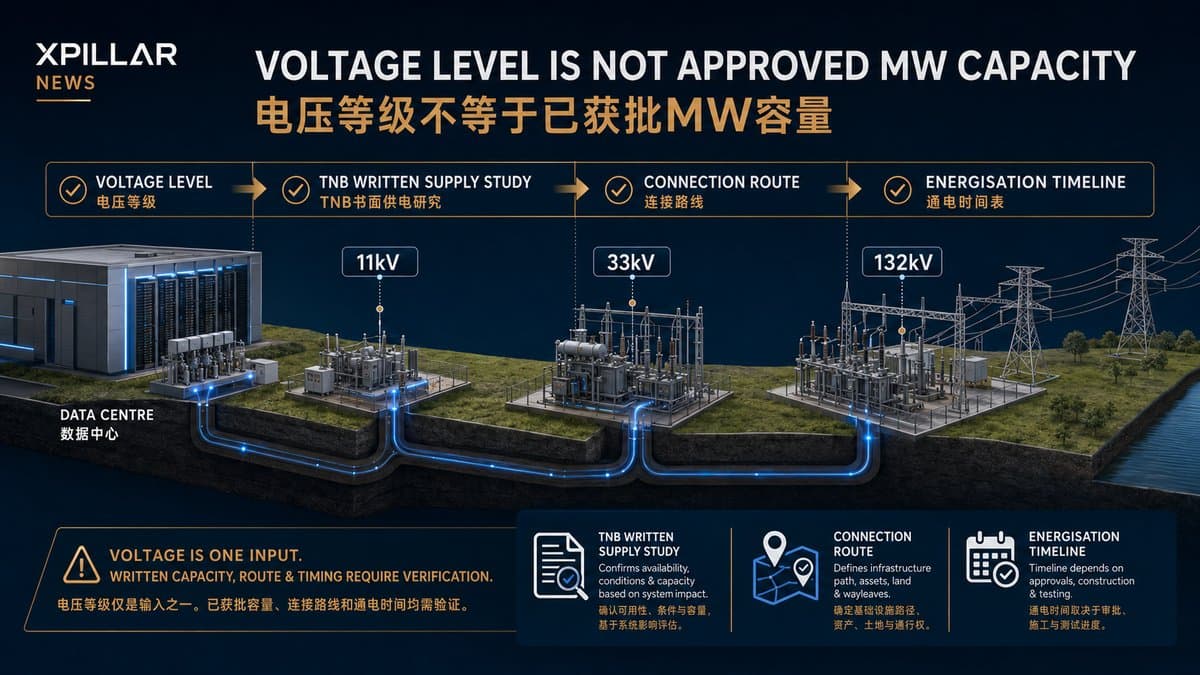
What do TNB 11kV, 33kV and 132kV tell you?
TNB 11kV、33kV和132kV代表什么?
TNB publishes the following general supply-voltage ranges. The actual voltage and capacity remain subject to the network and the individual application.
根据TNB公开的一般供电范围,实际电压及容量仍须视当地电网和个别申请而定。
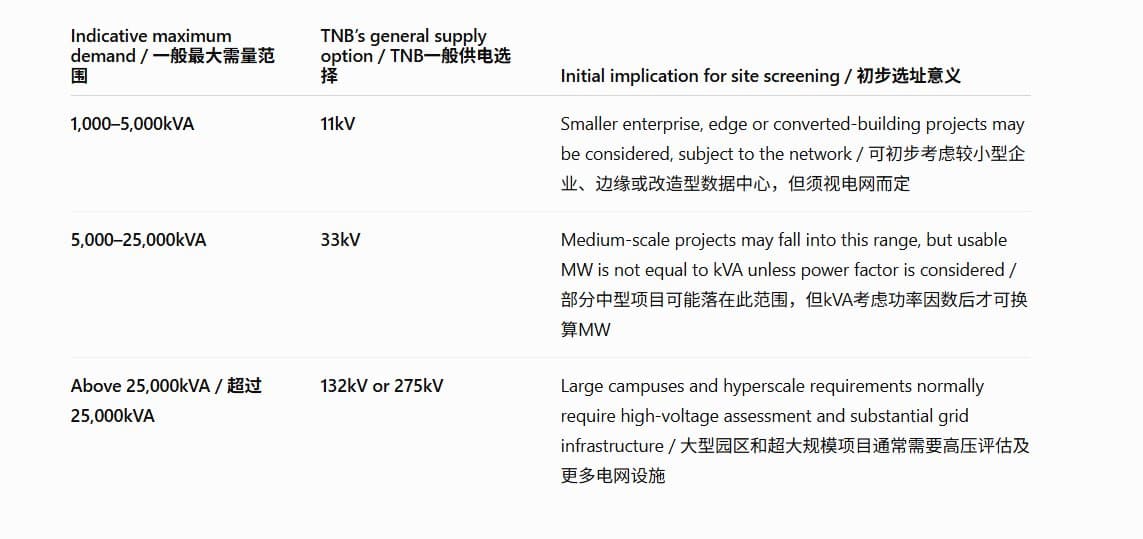
Two cautions are essential.
必须注意两点。
First, kVA is apparent power, while MW is real power. A simplified relationship is:
第一,kVA是视在功率,MW是有功功率。简化关系为:
MW ≈ MVA × power factor
MW ≈ MVA × 功率因数
For example, 25MVA at a power factor of 0.90 is approximately 22.5MW—not 25MW. The engineer and utility must use the applicable design and contractual requirements.
例如25MVA在0.90功率因数下约等于22.5MW,并不是25MW。实际计算必须采用工程师及电力公司的适用要求。
Second, “there is a 33kV line beside the land” only identifies nearby infrastructure. It does not confirm spare capacity, fault level, permissible tapping arrangement, network reinforcement, wayleave, connection cost, programme or supply security. Only a site-specific written response can establish whether the proposed load is feasible.
第二,“土地旁边有33kV线路”只证明附近可能有电力设施,并不能证明有剩余容量,也不能确认短路水平、接驳方式、电网加固、通行权、接电费用、施工时间或供电可靠性。只有针对该地块的书面答复,才能支持项目判断。
Can land size be calculated from TNB power? 可以根据TNB电力反推土地面积吗?
Only as an early planning scenario—not as a fixed TNB formula.
只能作为早期规划情景,不能当作TNB固定公式。
Developers may use a density assumption such as critical IT MW per gross acre, but the result varies greatly according to building height, rack density, cooling technology, setbacks, stormwater requirements, on-site substation, generator yard, fuel storage, internal roads and future phases.
开发商可能采用“每英亩可容纳多少IT MW”的密度假设,但结果会受到建筑层数、机柜密度、冷却技术、退界、雨水管理、站内变电站、发电机区域、燃油储存、内部道路及未来扩建影响。
The screening calculation is:
初筛公式是:
Indicative gross land = target IT capacity ÷ assumed IT-density per gross acre
初步土地面积 = 目标IT容量 ÷ 每英亩假设IT密度
For illustration only, if a concept team tests a range of 1.0 to 2.0MW of IT capacity per gross acre, the scenarios would be:
仅作示范,如果概念团队采用每英亩1.0至2.0MW IT容量的范围:
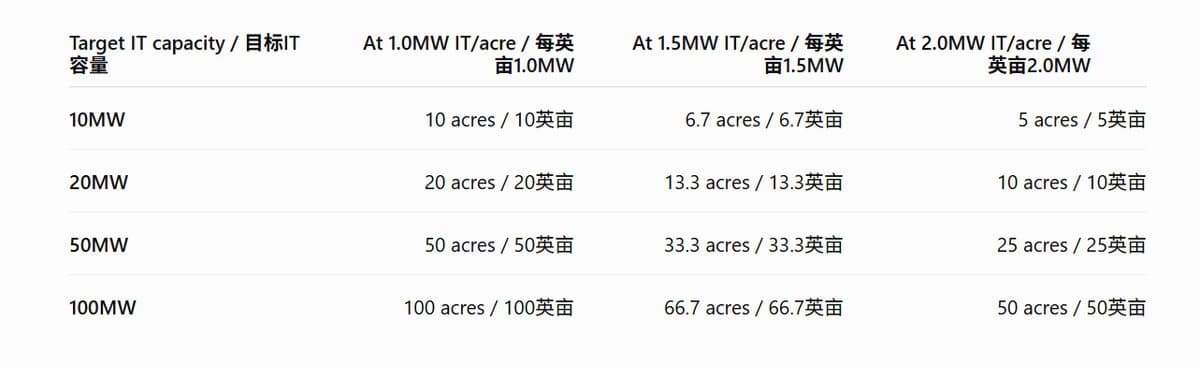
These figures are XPillar screening scenarios, not an official Malaysian entitlement or universal industry standard. A single-storey, air-cooled campus with generous redundancy may need much more land. A multi-level, liquid-cooled urban facility may achieve a higher density but face greater structural, fire, construction and operational complexity.
以上属于XPillar初筛情景,并非马来西亚官方许可标准或统一行业标准。采用单层建筑、空气冷却及较大冗余空间的园区可能需要更多土地;采用多层建筑及液冷的城市型项目可能提高密度,但结构、消防、施工与营运复杂度也会增加。
The land calculation should therefore be tested in both directions:
因此必须从两个方向测试:
Power-led: given a credible grid capacity, how much IT load can the chosen PUE and design support?
从电力出发: 在可信的电网容量下,采用目标PUE和设计后能够支持多少IT负载?
Land-led: given the net developable area and planning envelope, how many data halls and how much supporting plant can actually fit?
从土地出发: 扣除所有限制后的净可开发面积,实际能够容纳多少数据大厅和配套设备?
The lower feasible result becomes the practical first-stage capacity.
两个结果中较低的一项,才是较实际的第一阶段容量。
Gross acreage is not developable acreage
地契面积不等于净可开发面积
A land title may state 30 acres, but the complete 30 acres will rarely be available for data halls. The concept plan must deduct or accommodate:
地契可能写30英亩,但通常不能把全部土地都用作数据大厅。概念总图必须扣除或容纳:
- road reserves, building setbacks and landscape requirements;
道路保留地、建筑退界和绿化要求;
- rivers, drainage reserves, retention ponds and flood mitigation;
河流、排水保留地、蓄洪池及防洪设施;
- slopes, unsuitable soil or geotechnical constraints;
斜坡、软土及其他岩土限制;
- TNB intake, switching or high-voltage substation requirements;
TNB进线、开关站或高压变电站空间;
- transmission corridor, wayleave and cable routes;
输电走廊、通行权及电缆路线;
- generator and transformer yards, chillers or cooling equipment;
发电机、变压器、冷水机组和冷却设备;
- fuel storage, fire access and hazardous-material separation;
燃油储存、消防通道及危险品安全距离;
- loading, security standoff, parking and internal circulation; and
装卸、保安缓冲、停车及内部交通;以及
- land reserved for later phases.
未来发展阶段的保留土地。
This is why a clean, regularly shaped industrial parcel with two practical access points can be more valuable to a data centre developer than a larger irregular site.
因此,一块形状方正、规划清楚并具有两个实用出入口的工业地,可能比面积更大但形状不规则的土地更有价值。
The 12 checks data centre developers make before shortlisting land
数据中心开发商筛选土地的12项条件
1. Exact coordinates and title boundaries 准确坐标和地契边界
Provide the lot number, mukim, district, title, survey plan, coordinates, gross area and site shape. “Near Cyberjaya” or “in Johor” is not enough for network and planning assessment.
提供地段编号、mukim、地区、地契、测量图、坐标、总面积及地块形状。“靠近Cyberjaya”或“位于柔佛”不足以进行电网和规划评估。
2. Land category, express conditions and restrictions 土地用途、明文条件及限制
Confirm the registered land use, zoning, local-plan designation, express conditions, restrictions in interest and whether conversion or consent is required. Do not advertise a site as “data-centre approved” without documentary evidence.
确认地契用途、规划分区、地方规划指定用途、明文条件、权益限制,以及是否需要转换用途或取得同意。没有文件证明时,不应宣传为“已获数据中心批准”。
3. Target IT capacity and phases 目标IT容量和发展阶段
A useful brief states the intended IT load for Phase 1, ultimate campus capacity and required energisation dates. A request for “as much power as possible” is too vague for serious feasibility work.
清楚列出第一期IT负载、整个园区最终容量及各阶段目标通电日期。只说“尽量申请最多电力”无法支持正式可行性研究。
4. Formal TNB power feasibility 正式TNB电力可行性
Identify the proposed maximum demand, supply voltage, connection point, reinforcement works, lead time, charges, land to be surrendered or reserved, and wayleave requirements. A landowner’s old bill or a nearby pylon is not a capacity approval.
核实拟申请最大需量、供电电压、接电点、电网加固、交付时间、费用、须保留或移交的土地及通行权。旧电费单或附近电塔不能证明容量已经获批。
5. Space for electrical infrastructure 电力设施空间
The parcel must accommodate the utility intake and the customer’s transformers, switchgear, UPS, batteries, generators and safe maintenance access. Larger HV connections may materially change the master plan.
土地必须容纳电力公司进线设备,以及客户的变压器、开关设备、UPS、电池、发电机和安全维修通道。大型高压接电会明显影响总图设计。
6. Power resilience and phasing 供电韧性和分期
Developers will assess network arrangement, outage exposure and whether capacity can be delivered in phases. “Two cables” does not necessarily mean two independent grid sources.
开发商会评估网络结构、停电风险及容量能否分期提供。“两条电缆”不一定代表两个独立电网来源。
7. Diverse fibre routes 多路径光纤
Confirm nearby carriers, duct availability, latency and the possibility of physically diverse entrances. Multiple carriers using the same road reserve do not provide true route diversity.
核实附近运营商、管道、网络延迟及能否从不同方向进入。多家运营商共同使用同一道路保留地,并不等于真正的路线多样性。
8. Water and cooling strategy 水源与冷却方案
Malaysia’s sustainable data centre guideline recommends avoiding water-stressed locations and uses Water Usage Effectiveness as a performance measure. The site must be assessed against the proposed cooling technology, water source, storage, discharge and future restrictions—not merely the diameter of a nearby pipe.
马来西亚可持续数据中心指南建议避开水资源压力较高的地区,并以WUE评估用水效率。必须根据实际冷却技术、水源、储水、排放及未来限制评估,不能只看附近水管直径。
9. Flood, drainage and climate exposure 洪水、排水及气候风险
Check flood records, platform level, drainage outfall, retention needs and access during extreme weather. Critical equipment and fuel systems may require additional elevation and protection.
检查历史洪水、平台标高、排水出口、蓄洪要求,以及极端天气下道路是否仍可通行。关键设备及燃油系统可能需要进一步抬高和保护。
10. Access and construction logistics 道路与施工运输
Transformers, generators and prefabricated modules may be exceptionally heavy or oversized. The team must assess bridge limits, junction geometry, road width, crane access and construction staging.
变压器、发电机和预制模块可能超重或超宽。必须检查桥梁承载、路口转弯、道路宽度、吊车位置及施工分期空间。
11. Environmental, fire and fuel requirements 环境、消防及燃油要求
Backup generation, fuel storage, batteries, noise, emissions and cooling systems may trigger technical studies and authority requirements. These facilities need space as well as approvals.
备用发电、燃油储存、电池、噪音、排放及冷却系统可能需要技术研究和主管机关审批。这些设施不仅要获批,也需要实际土地空间。
12. Neighbours, security and expansion control 邻近用途、保安与扩建控制
Data centres value controlled surroundings. Incompatible adjacent uses, smoke, dust, vibration, hazardous operations, future high-rise obstruction or the inability to secure expansion land may weaken a site.
数据中心重视周边环境可控性。附近若有烟尘、粉尘、震动、危险工业,未来可能出现不利高层建筑,或无法控制扩建土地,都会降低地块吸引力。
What should a landowner send to XPillar?
地主应提交什么资料给XPillar?
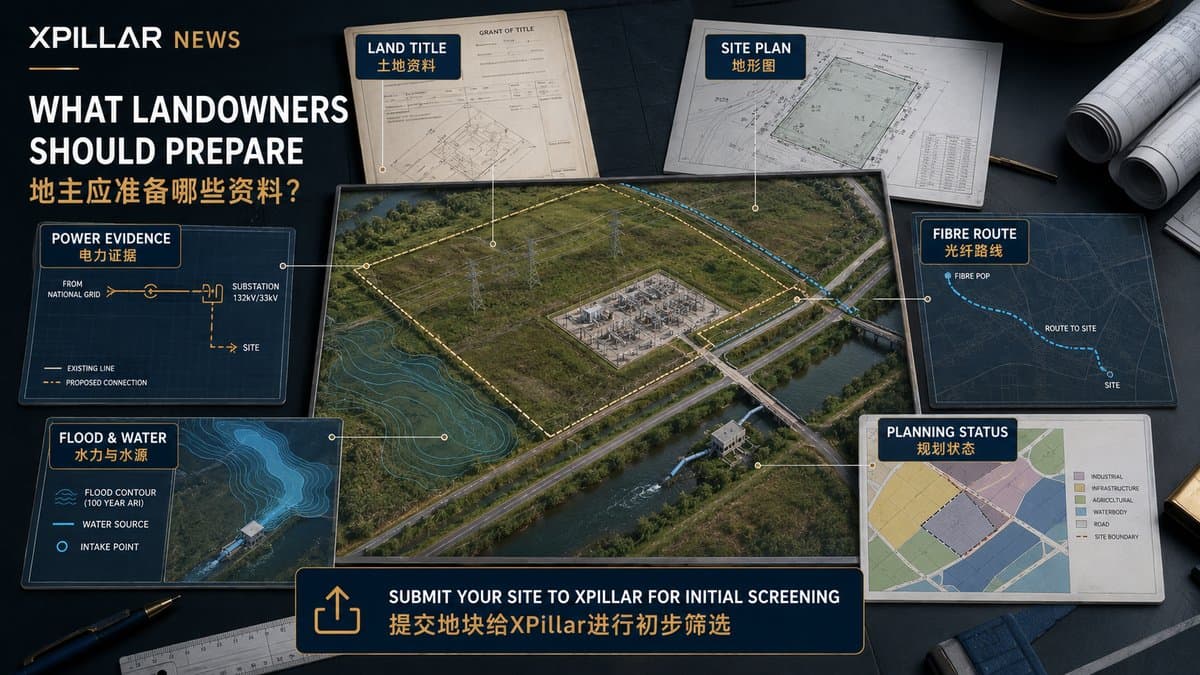
To let XPillar conduct a structured initial screen and introduce credible sites to relevant data centre parties, prepare:
为了让XPillar进行结构化初筛,并把具备证据的地块介绍给合适的数据中心相关方,建议准备:
- title and latest official land search; 地契及最新正式土地查册;
- survey plan, coordinates and KML/KMZ boundary file if available; 测量图、坐标及KML/KMZ边界文件;
- zoning or planning information; 规划分区或规划资料;
- asking price and proposed sale, lease or joint-venture structure; 售价及出售、出租或合资条件;
- current land use, occupancy and vacant-possession timeline; 目前用途、占用情况及可交地时间;
- topographic, flood, geotechnical and infrastructure reports if available; 地形、防洪、岩土及基础设施报告;
- road-access information and site photographs; 道路资料及现场照片;
- water-supply and sewerage information; 供水及排污资料;
- nearby fibre information supported by carrier evidence where available; and 有运营商证据支持的光纤资料;以及
- every TNB letter, application, load study, connection proposal or approval connected to the precise lot. 与准确地块有关的所有TNB信函、申请、负载研究、接电建议或批准。
Do not describe the property as “100MW ready” unless the capacity, connection arrangement and delivery conditions are supported by current written evidence for that land.
除非有当前书面文件支持该地块的容量、接电方案及交付条件,否则不要把土地宣传为“100MW ready”。
A better way to market data centre land
怎样更专业地推广数据中心土地?
The strongest data centre land listing is not the one with the largest acreage. It is the one that reduces uncertainty.
最有吸引力的数据中心土地不一定面积最大,而是能够降低不确定性的土地。
Instead of writing:
不要只写:
50 acres, next to TNB line, suitable for data centre.
50英亩,靠近TNB电线,适合数据中心
Prepare a site brief that states:
更专业的地块简介可以写:
50-acre industrial-zoned parcel; title and boundary verified; net developable area subject to concept plan; target Phase 1 and ultimate load identified; formal TNB feasibility in progress; preliminary fibre, water, flood and heavy-access evidence available in the data room.
50英亩工业规划地;地契及边界已核实;净可开发面积须经概念总图确认;第一期及最终目标负载已确定;正式TNB可行性评估进行中;资料室备有初步光纤、水源、防洪及重型车辆通行证据。
That wording is more credible because it separates verified facts, pending studies and commercial assumptions.
这种表达把已核实事实、待完成研究及商业假设分开,更容易获得专业选址团队信任。
Looking for data centre land—or do you own a potential site?
你正在寻找数据中心土地,或拥有潜在地块?
XPillar connects industrial land intelligence with real operating requirements. We can help owners organise the site information needed for an initial screen and help occupiers or developers search for land based on location, power, fibre, water, approvals, access and expansion needs.
XPillar把工业地产资料与企业真实营运要求连接起来。我们可以协助地主整理初筛所需资料,也可根据地点、电力、光纤、水源、规划、交通及扩建条件,为开发商和营运商寻找土地。
For landowners: submit your title, coordinates, acreage, asking terms and all available TNB documentation.
地主: 请提交地契、坐标、面积、交易条件及所有TNB相关文件。
For data centre developers and site-selection teams: send us your preferred state or corridor, Phase 1 and ultimate IT load, target energisation date, land range, tenure and infrastructure requirements.
数据中心开发商及选址团队: 请提供目标州属或走廊、第一期和最终IT负载、目标通电日期、土地面积范围、产权方式及基础设施要求。
Xpillar’s initial screen does not constitute a TNB capacity confirmation, engineering design, valuation, planning approval or legal opinion. It helps identify the evidence and gaps before both sides invest time in detailed due diligence.
Xpillar的初筛不构成TNB容量确认、工程设计、估值、规划批准或法律意见;它的作用是在双方投入详细尽调前,先找出已有证据及关键缺口。
Frequently Asked Questions
常见问题
1. Does land beside a TNB substation automatically have available power?
土地靠近TNB变电站,是否自动代表有电力容量?
No. Distance is relevant, but spare capacity, network configuration, connection method, reinforcement, wayleave, cost and delivery date must be assessed for the precise application.
不是。距离只是其中一个因素。剩余容量、网络结构、接驳方法、电网加固、通行权、费用及交付日期都必须按具体申请评估。
2. Is 33kV enough for a data centre?
33kV是否足够建设数据中心?
It can support certain medium-scale requirements. TNB’s published general range for 33kV is 5,000–25,000kVA maximum demand. The project’s MW requirement, power factor, PUE, phasing and local network determine whether it is suitable.
它可能支持部分中型需求。TNB公开的一般33kV范围为5,000至25,000kVA最大需量,但仍须根据MW需求、功率因数、PUE、分期及当地电网判断。
3. When is 132kV normally considered?
什么情况下通常考虑132kV?
TNB generally identifies 132kV or 275kV for exceptional loads above 25,000kVA. Large data centre campuses commonly require HV assessment, but the final solution is site- and network-specific.
TNB一般把132kV或275kV列为超过25,000kVA的超高负载供电选项。大型数据中心园区通常需要高压评估,但最终方案仍取决于地块和电网。
4. How many acres are needed per MW?
每MW需要多少英亩?
Malaysia does not have one universal acreage-per-MW rule. Density changes with building form, cooling, redundancy, setbacks, substations, stormwater, generators and expansion. Use a range for early screening and validate it with a concept master plan.
马来西亚没有统一的每MW土地标准。建筑形式、冷却、冗余、退界、变电站、排水、发电机和扩建都会改变密度。早期可用一个范围进行初筛,之后必须通过概念总图验证。
5. Can XPillar confirm TNB power capacity?
XPillar能否确认TNB电力容量?
XPillar can organise land and requirement information and support initial property screening. Only TNB’s formal process and the appointed competent professionals can confirm the supply solution and technical design.
XPillar可以整理土地和客户需求资料,并协助工业地产初筛。只有TNB正式流程及受委任的合格专业人士能够确认供电方案和技术设计。
6. What is the most important document when marketing a power-ready site?
推广“电力就绪”土地时,最重要的文件是什么?
A current, site-specific written TNB response or agreement is far stronger than a verbal statement, nearby infrastructure photograph or old electricity bill. Its scope, load, voltage, phase, conditions and delivery date must also match the proposed project.