
Answer first 先说结论
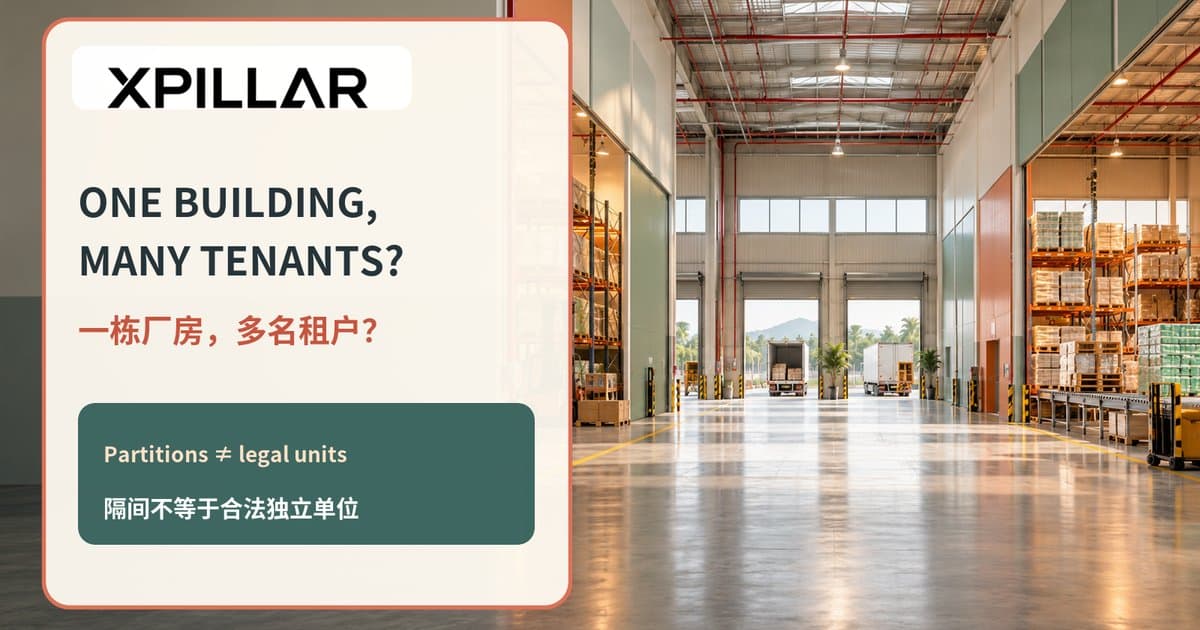
Yes, a Malaysian factory or warehouse may sometimes accommodate multiple tenants, but drawing rental boundaries or installing partitions does not by itself create lawful, safe or separately transferable industrial units.
可以,马来西亚厂房或仓库在某些情况下可以容纳多名租户;但划出租赁范围或安装隔间,并不会自动形成合法、安全或可独立转让的工业单位。
The proposal must be tested against the land and building approvals, the current state-gazetted building by-laws, fire-compartment and escape design, each occupier’s activity, electrical and other utility arrangements, access rights, licences and the lease structure.
项目必须同时核对土地与建筑批准、现行州属建筑附例、防火分区与逃生设计、每名使用者的业务、公用设施安排、通行权、执照及租约结构。
The strongest evidence is not a broker’s floor sketch.
最有力的证据不是经纪绘制的平面草图。
It is a matched set comprising the title and restrictions, approved planning and building drawings, CCC or CFO records, written local-authority permission for proposed partitions, BOMBA-approved fire drawings and current fire-system records, electrical registration and load information, utility-account arrangements, business-licence requirements and signed contracts allocating every shared responsibility.
真正有力的证据是一套相互吻合的文件:地契及限制、核准规划与建筑图则、CCC或CFO记录、地方政府对拟建隔间的书面批准、BOMBA核准消防图及现行消防系统记录、电气装置登记与负荷资料、公用事业账户安排、营业执照要求,以及清楚分配所有共用责任的合同。
Three different things that must not be confused 三个不能混为一谈的概念
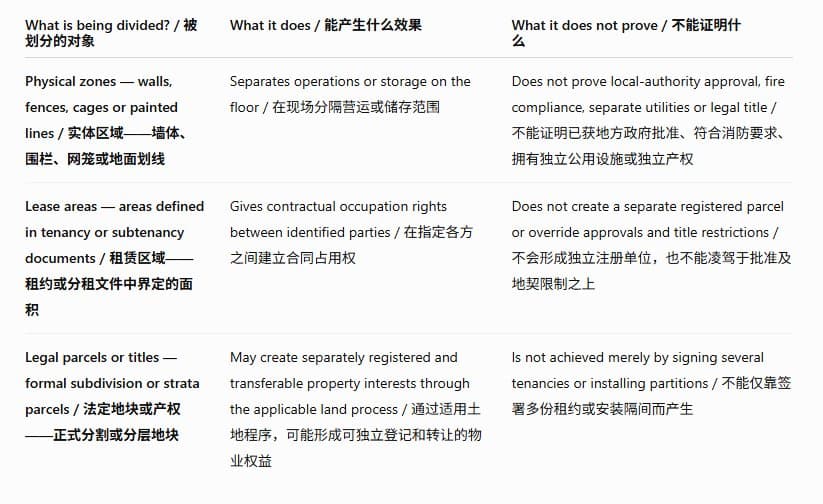
Malaysia’s Strata Titles Act 1985 is legislation for subdivision of buildings or land into registered parcels.
马来西亚《1985年分层地契法令》规范把建筑物或土地分割为注册地块。
That is a different legal outcome from internally leasing several zones inside one industrial building.
这与在同一工业建筑内把多个区域分别出租,是完全不同的法律结果。
Why the partition itself matters legally 为什么隔间本身具有法律意义
Section 79(1) of the Street, Drainage and Building Act 1974 states that a person must not erect or permit a partition, compartment, gallery, loft, roof, ceiling or other structure in a building without the local authority’s prior written permission.
《1974年街道、排水及建筑法令》第79(1)条规定,未经地方政府事先书面批准,不得在建筑物内建造或允许建造隔间、分隔空间、楼台、阁楼、屋顶、天花板或其他结构。
Section 79(3) allows the local authority to remove an unauthorised structure and recover the cost from the owner.
第79(3)条允许地方政府拆除未经批准的结构,并向业主追讨费用。
Sections 70(11) to 70(13) also address unauthorised alteration, use of a building or part for another purpose, and deviation from approved plans.
第70(11)至70(13)条也涉及未经批准的改动、把建筑物或其部分改作其他用途,以及偏离核准图则。
If the proposal amounts to “development” or a material change of use, section 19 of the Town and Country Planning Act 1976 prohibits carrying it out without planning permission.
如果方案构成“发展”或实质用途变更,《1976年城乡规划法令》第19条禁止在未取得规划许可的情况下实施。
The exact application depends on the location and facts, so the local planning authority should confirm the approval route in writing.
具体要求取决于地点和事实,因此应由当地规划机构书面确认正确的审批程序。
Building by-laws are gazetted by state.
建筑附例由各州颁布。
A national model or an old consultant’s reference is not enough; check the version currently gazetted for the relevant state or federal territory.
仅引用全国示范文本或旧顾问资料并不足够,必须查阅相关州属或联邦直辖区当前已颁布的版本。
The 12 checks before buying, leasing or partitioning购买、承租或隔间前的12项检查
1. Define the legal and operating model 先定义法律与营运模式
Is the owner granting licences to occupy, direct tenancies, subtenancies or intending formal parcel subdivision?
业主提供的是占用许可、直接租约、分租,还是计划正式分割产权?
Will each user have exclusive possession, or only a designated operating zone inside one managed facility?
每名使用者是否拥有专属占用权,抑或只是在统一管理设施内使用指定区域?
The answer determines the documents, consent, control and risk allocation required.
答案会决定所需文件、同意、控制及风险分配方式。
2. Check title, restrictions and consent 核对地契、限制与同意
Review the title category, express conditions, restrictions in interest, private caveats, charges and any master tenancy.
审查地契类别、明示条件、权益限制、私人土地留置、抵押及主租约。
Confirm whether the owner, lender, head landlord, developer or management body must consent.
确认是否需要业主、融资机构、总业主、发展商或管理机构同意。
A head tenant should not promise a subtenant more rights than the head lease permits.
主租户不能向分租户承诺超过主租约所允许的权利。
3. Match every tenant’s actual activity to planning approval 把每名租户的实际业务与规划批准逐一匹配
“Industrial” is not one universal use.
“工业用途”并不是一种万能用途。
Warehousing, assembly, food production, chemical storage, repair, data-centre support and worker facilities can create different planning, environmental, fire, traffic and licensing questions.
仓储、装配、食品生产、化学品储存、维修、数据中心支援及员工设施,可能触发不同的规划、环保、消防、交通和执照要求。
Prepare an activity schedule for each tenant, including materials, headcount, operating hours, vehicles, machinery and emissions.
应为每名租户编制业务清单,列明物料、人数、营运时间、车辆、机器及排放。
4. Reconcile proposed partitions with approved drawings 把拟建隔间与核准图则逐项比对
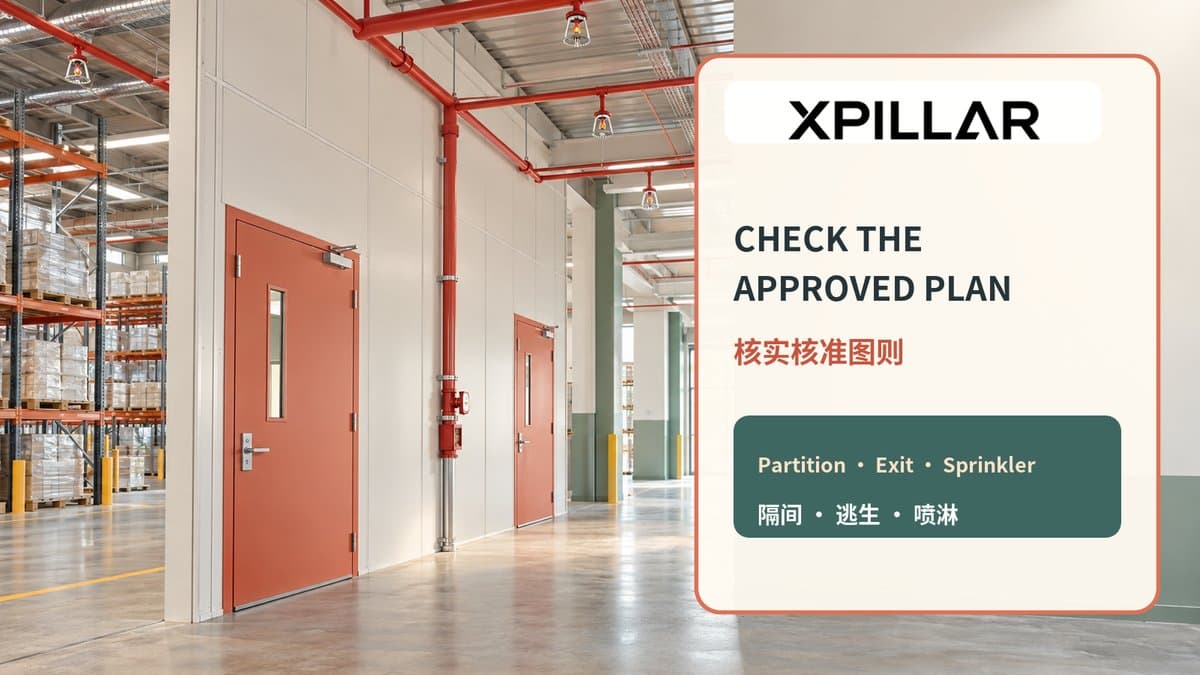
Overlay the proposed tenancy plan on the approved architectural, M&E and fire drawings.
把拟议租赁平面图叠加在核准建筑、机电及消防图上。
Mark every new wall, door, ceiling, platform, office, storage cage and service penetration.
标明每一道新墙、门、天花板、平台、办公室、储物网笼及管线穿孔。
Obtain the local authority’s written direction on submission and approval before work starts.
施工前应取得地方政府对申报及批准程序的书面指示。
Landlord consent alone is not statutory approval.
业主同意并不等于法定批准。
5. Recalculate fire compartments and fire resistance 重新计算防火分区与耐火等级
A new boundary may cut across a fire compartment, a fire-rated wall or an uncompartmented space assumed in the original design.
新的租赁边界可能穿过原有防火分区、耐火墙,或改变原设计所假设的开放空间。
Verify wall and door ratings, junctions with the roof, penetrations, shutters, smoke control and whether the proposed tenant mix introduces incompatible hazards.
必须核实墙体及防火门等级、墙顶连接、穿孔封堵、防火卷帘、排烟,以及租户组合是否引入不相容风险。
6. Prove independent and shared escape routes 证明独立及共用逃生路线可用
Each occupied area needs a compliant path to safety.
每个占用区域都必须有合规的安全疏散路径。
Check travel distance, exit width and number, door swing, emergency lighting, exit signs, final exits and whether one tenant can lock, obstruct or store goods in another tenant’s escape route.
核实逃生距离、出口宽度及数量、开门方向、应急照明、出口标志、最终出口,并确认任何租户都不能锁闭、阻挡或在另一租户的逃生通道堆货。
Shared egress needs legally enforceable 24-hour access.
共用逃生路线必须拥有可执行的全天候通行权。
7. Test the whole fire-protection system after partitioning 隔间后重新测试整套消防系统
New walls and ceilings can leave sprinkler heads on the wrong side, create unprotected pockets or disrupt alarm zoning, hose-reel reach and smoke-control assumptions.
新墙和天花板可能令喷淋头落在错误一侧,形成无保护死角,或破坏火警分区、消防喉辘覆盖及排烟设计假设。
Confirm the design with qualified professionals and BOMBA where required, then test and document the completed system.
应由合资格专业人士确认设计,并在需要时取得BOMBA审核,之后对完工系统进行测试和记录。
BOMBA’s current Fire Certificate guidance lists qualifying factory and storage premises and states that designated premises require a Fire Certificate.
BOMBA现行消防证书指引列出适用的厂房与仓储场所,并规定指定场所须取得消防证书。
8. Build a lawful, safe utility architecture 建立合法且安全的公用设施架构
Separate the concepts of capacity, physical distribution, measurement and billing.
必须区分容量、实体配电、计量和收费四个概念。
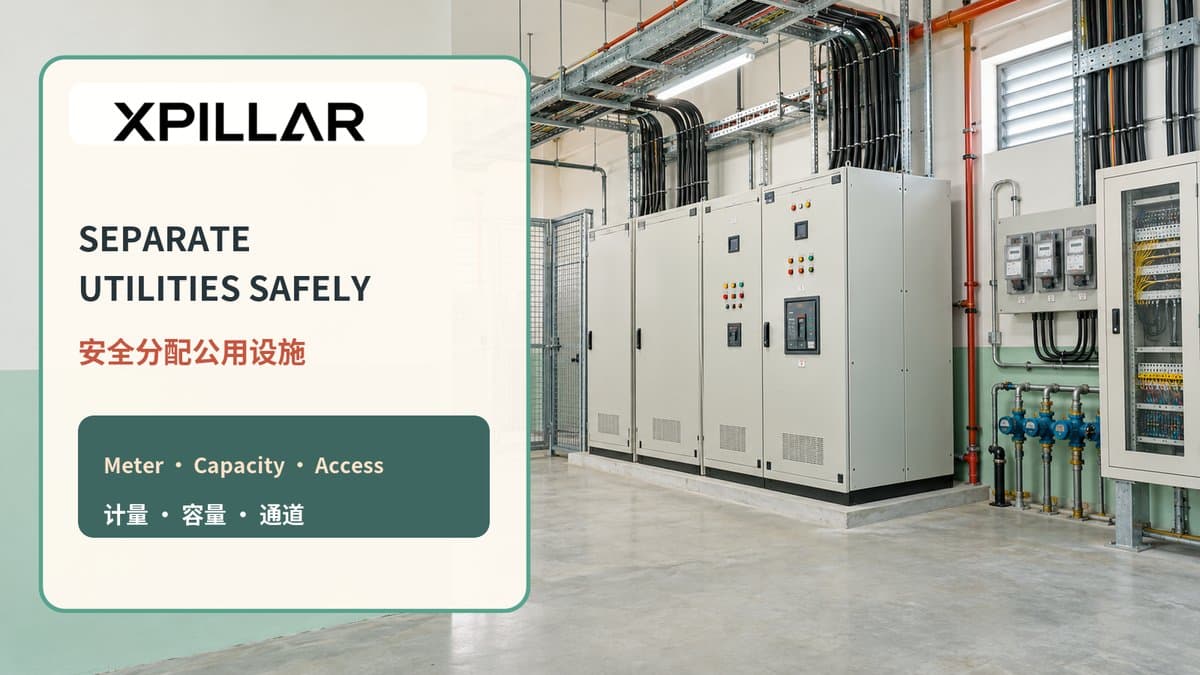
For electricity, obtain the single-line diagram, maximum demand, switchboard and protection details, cable routes, metering proposal and controlled access arrangement.
电力方面,应取得单线图、最大需量、开关板及保护资料、电缆路径、计量方案和受控进入安排。
Decide whether tenants will have utility accounts, approved meters or contractual sub-metering, and obtain written confirmation from the utility or regulator where necessary.
确定租户采用独立公用事业账户、核准电表还是合同分表计量,并在需要时向公用事业公司或监管机构取得书面确认。
The Energy Commission states that installations must be registered unless excluded, a valid Certificate of Registration is required to possess or operate a registrable installation, and the certificate cannot be transferred without the Commission’s permission.
能源委员会说明,除非获豁免,电气装置必须登记;应登记装置须持有有效登记证书方可拥有或操作,而证书未经委员会许可不得转让。
9. Allocate water, sewerage, effluent and waste responsibilities 分配供水、排污、废水与废弃物责任
Map potable water, process water, toilets, sewer connections, trade-effluent points, stormwater and waste-storage areas.
绘制饮用水、生产用水、厕所、污水接驳、工业废水排放点、雨水系统及废弃物储存区。
A shared pipe does not mean every discharge is permissible.
共用管道并不代表任何排放都被允许。
State who monitors, maintains, pays, reports failures and bears liability if one tenant contaminates or overloads a shared system.
合同应写明由谁监测、维修、付款、报告故障,并在某租户污染或超载共用系统时承担责任。
10. Prove that access and logistics can coexist 证明出入口与物流动线能够共存
Measure gate capacity, truck turning, dock allocation, parking, queueing, fire-appliance access, loading hours, security, visitor control and after-hours entry.
测量大门容量、货车转弯、月台分配、停车、排队、消防车通道、装卸时间、保安、访客管理及非办公时间进入安排。
Test peak periods, not only the quiet site visit.
评估应采用高峰时段,而不是只参考安静的看房时刻。
Record which route is exclusive, shared, emergency-only or subject to booking.
明确哪些路线属于专用、共用、仅供紧急使用或须预约。
11. Match licences, addresses, insurance and emergency control 匹配执照、地址、保险与应急控制
Confirm how each tenant’s premises address will be described, whether each activity can obtain the required business and operational licences, and how emergency responders identify the occupied zone.
确认每名租户的场所地址如何表述、各项业务能否取得所需营业及营运执照,以及紧急单位如何识别其占用区域。
Require evidence of insurance, public liability, fire and machinery cover appropriate to each activity, and disclose neighbouring tenant risks to insurers.
要求租户提供与其业务相匹配的财产、公众责任、火灾及机器保险证明,并向保险公司披露相邻租户风险。
12. Put every shared obligation into the transaction documents 把所有共用义务写入交易文件
The offer, tenancy or subtenancy should attach a controlled plan and state the approved use, commencement conditions, fit-out approval, utilities, common-area rules, service charges, repairs, statutory inspections, access, insurance, incident reporting, default, reinstatement and change-control procedure.
要约、租约或分租约应附上受控平面图,并写明核准用途、起租条件、装修审批、公用设施、共用区域规则、服务费、维修、法定检验、通行、保险、事故报告、违约、复原及变更控制程序。
Identify what happens if an authority refuses the partition or a neighbouring tenant changes activity.
还应明确:若主管机关拒绝隔间,或相邻租户改变业务,如何处理。
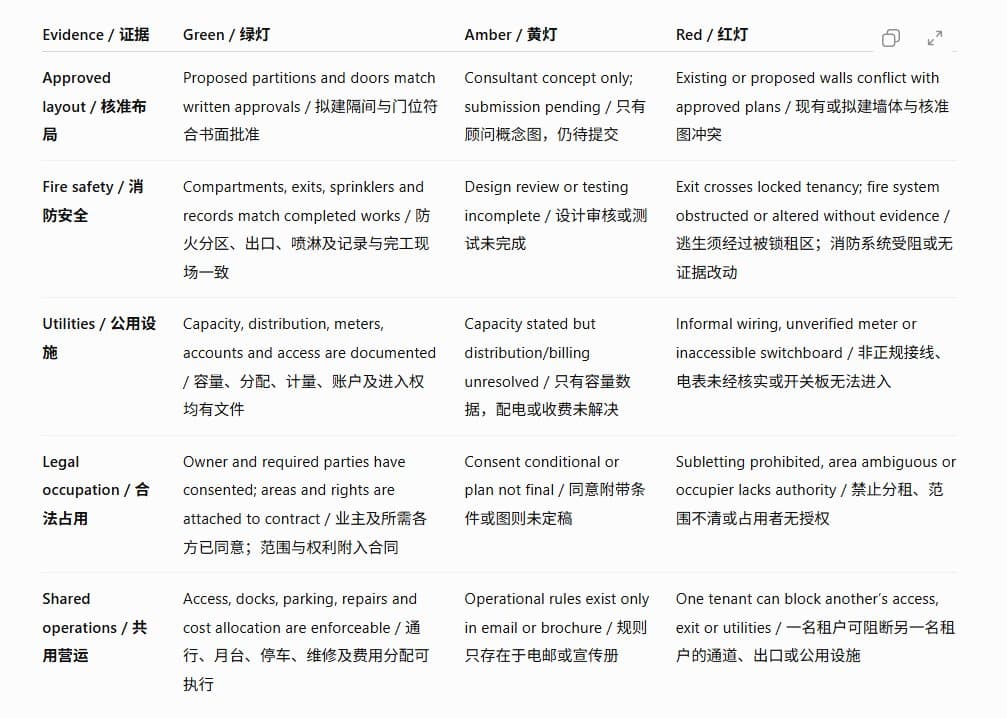
Evidence matrix for a transaction team交易团队证据矩阵
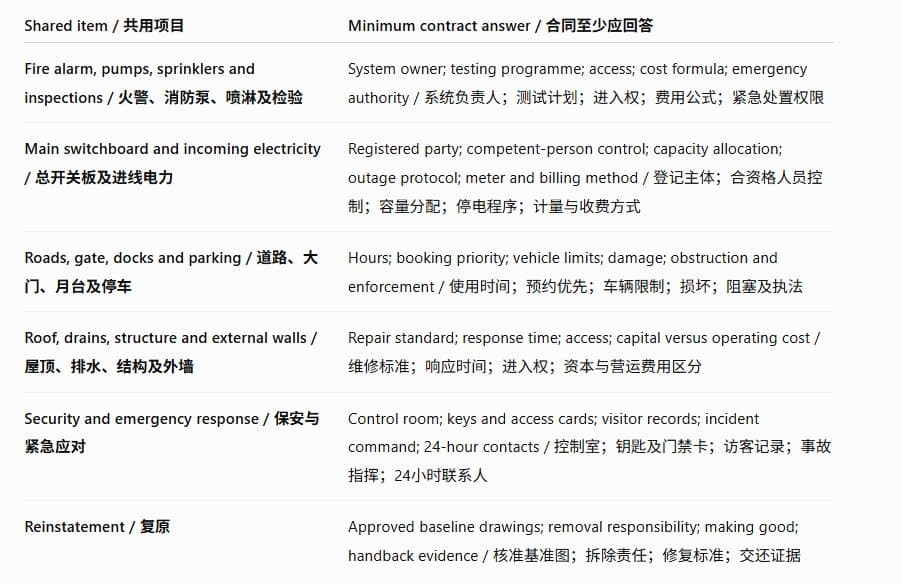
Shared-cost schedule: do not leave it to “reasonable sharing”共用费用表:不要只写“合理分摊”
A practical pre-commitment sequence实用的承诺前流程
Freeze each tenant’s activity, headcount, material and operating profile.
固定每名租户的业务、人数、物料及营运资料。
Obtain title, approved planning/building/fire drawings, CCC/CFO and current system records.
取得地契、核准规划/建筑/消防图、CCC/CFO及现行系统记录。
Overlay the proposed tenancy plan and identify every approval, utility and access change.
叠加拟议租赁图,找出所有审批、公用设施及通行变化。
Obtain written PBT, BOMBA, utility and other technical directions required for the actual proposal.
根据实际方案,取得地方政府、BOMBA、公用事业及其他技术单位所需的书面指示。
Price the compliant works, approval time, testing, downtime and reinstatement—not only the partition contractor’s quotation.
计算合规工程、审批时间、测试、停产及复原成本,而不只看隔间承包商报价。
Make the transaction conditional on evidence that matters, with a long-stop date and exit mechanism.
把关键证据列为交易先决条件,并设置最迟完成日及退出机制。
Frequently Asked Questions 常见问题
1. Can a landlord partition a factory after all tenants agree? 所有租户同意后,业主就能直接为厂房做隔间吗?
No. 不能。
Contractual consent does not replace statutory approval.
合同同意不能取代法定批准。
Section 79 of Act 133 specifically requires prior written local-authority permission for partitions and certain other internal structures.
Act 133第79条明确要求,隔间及某些其他内部结构须事先取得地方政府书面许可。
2. Does the existing CCC automatically cover new tenancy partitions? 现有CCC会自动涵盖新的租赁隔间吗?
No. 不会。
A CCC records the approved building at its relevant completion stage; it is not automatic approval for later walls, doors, ceilings, platforms or changes of use.
CCC记录的是相关完工阶段的核准建筑,并不会自动批准日后新增的墙、门、天花板、平台或用途变化。
Compare the proposal with approved drawings and obtain the authority’s required approval.
应把方案与核准图则比对,并取得主管机关要求的批准。
3. Does a separate tenancy create a separate property title? 独立租约会形成独立产权吗?
No. 不会。
A tenancy creates contractual occupation rights.
租约只建立合同占用权。
A separately registered parcel or title requires the applicable land or strata process and official registration.
要形成独立注册地块或产权,必须完成适用的土地或分层程序并正式登记。
4. Can several tenants share one electricity meter? 多名租户可以共用一个电表吗?
Do not assume that an informal cost split is acceptable.
不要假设非正式分摊电费就可以。
Confirm the registered installation, capacity, meter and account arrangement, the legal basis for any sub-metering or recovery, switchboard access and the utility or Energy Commission requirements that apply to the exact setup.
应确认登记电气装置、容量、电表与账户安排、任何分表或费用回收的法律依据、开关板进入权,以及具体方案所适用的公用事业公司或能源委员会要求。
5. Must each tenant have a separate fire system? 每名租户都必须拥有独立消防系统吗?
Not necessarily. 不一定。
Every occupied area must remain protected by the approved integrated design.
但每个占用区域都必须继续受到核准整体设计的保护。
The responsible professionals should confirm compartmentation, detection, alarm zoning, sprinkler coverage, hose-reel reach, exits, testing and system control after partitioning.
隔间后,应由负责专业人士确认防火分区、侦测、火警分区、喷淋覆盖、消防喉辘范围、出口、测试及系统控制。
6. Can tenants with different industrial activities share one building? 不同工业业务的租户可以共用一栋建筑吗?
Sometimes, but compatibility must be proved.
有时可以,但必须证明相容性。
Compare fire load, hazardous materials, emissions, wastewater, noise, traffic, hygiene, security and operating hours, then verify each activity against planning and licence conditions.
应比较火灾荷载、危险物质、排放、废水、噪音、交通、卫生、保安及营运时间,再把各业务与规划及执照条件逐项核对。
7. What if the building already has several unapproved partitions? 如果建筑内已经有多道未经批准的隔间,怎么办?
Treat them as unresolved evidence, not free additional units.
应把它们视为未解决证据,而不是免费的额外单位。
Compare them with approved drawings, obtain professional fire and structural reviews, ask the local authority for the rectification route, and allocate removal or approval responsibility before committing.
须与核准图则比对,进行专业消防及结构审核,向地方政府确认纠正程序,并在承诺交易前分配拆除或补办责任。
8. What should be attached to the letter of offer or tenancy?要约书或租约应附上什么?
Attach a controlled plan showing exclusive and common areas, doors, exits, docks, parking, meters and services.
应附上受控平面图,标明专用及共用区域、门、出口、月台、停车、电表和服务设施。
Add the approved use, authority conditions, fit-out procedure, cost matrix, system-control rights, insurance, reinstatement and a change-control clause.
并加入核准用途、主管机关条件、装修程序、费用矩阵、系统控制权、保险、复原及变更控制条款。
Final decision rule 最终决策原则
Do not price the property as a collection of independent units until the evidence proves four things at the same time: each occupier can lawfully use its area, every person can escape safely, utilities and shared systems remain controllable, and the contracts preserve those rights throughout the term.
在证据同时证明以下四点之前,不要把物业按多个独立单位定价:每名使用者都能合法使用其区域、所有人员都能安全逃生、公用设施与共用系统仍可控制,以及合同能在整个租期内保障这些权利。
If any one is missing, the “multi-tenant premium” may instead be a rectification cost.
任何一项缺失,所谓“多租户溢价”都可能变成整改成本。
This article provides a due-diligence framework, not legal, engineering, fire-safety or regulatory advice. Requirements vary by state, local authority, building design and activity. Obtain written confirmation from the relevant authorities and qualified advisers for the actual property.
本文提供尽调框架,不构成法律、工程、消防或监管意见。要求会因州属、地方政府、建筑设计及业务而异;应就实际物业向相关主管机关及合资格顾问取得书面确认。