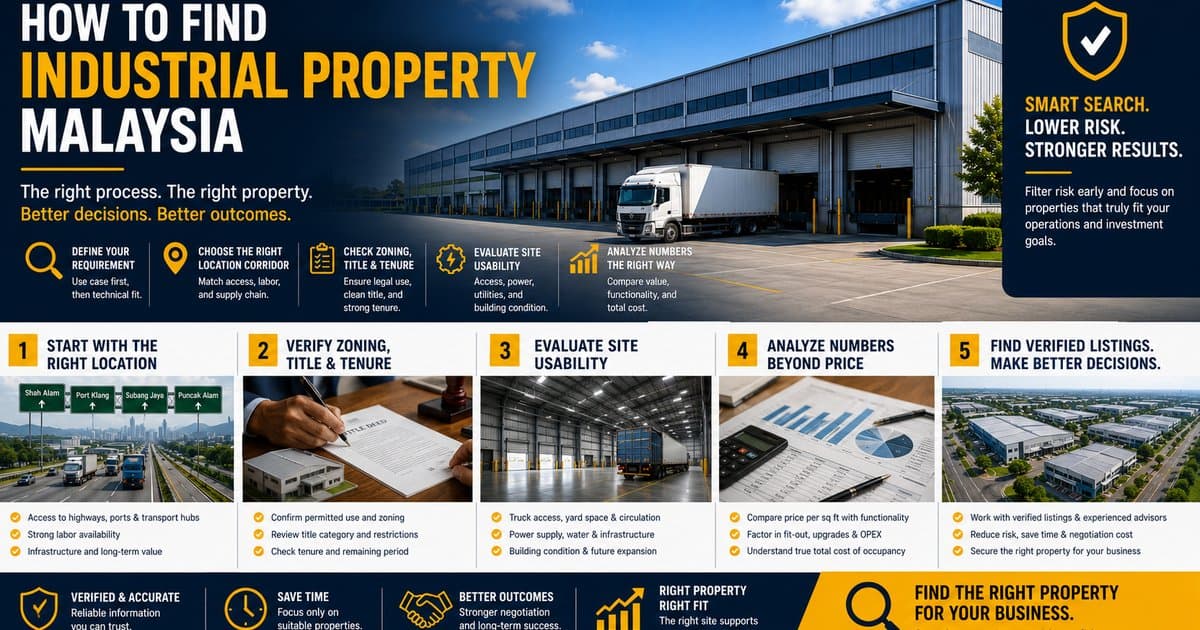
A warehouse that looks ideal on paper can fail the moment your trucks hit a narrow access road, your power load falls short, or the land title does not match your intended use. That is why knowing how to find industrial property Malaysia is less about scrolling listings and more about filtering risk early.
For investors, occupiers, and developers, the right search process saves months of wasted viewings and expensive negotiation dead ends. In Malaysia, especially across Selangor and the Klang Valley, industrial stock moves according to location quality, logistics access, tenure, zoning, and utility readiness. If one of those is off, the deal may still work, but only at the right price and for the right use case.
Start with your operating requirement, not the property brochure. Many buyers and tenants begin with budget and location, which matters, but that approach often produces a long shortlist of unsuitable assets. A better sequence is use case first, then technical fit, then price.
If you are a manufacturer, your key filters may include power supply, floor loading, worker access, and licensing compatibility. If you are a logistics operator, you are more likely to prioritize highway connectivity, loading bays, trailer turning, clear height, and distance to ports or urban delivery zones. If you are an investor, tenancy profile, yield potential, land value support, and future redevelopment options may carry more weight than immediate operational fit.
Once the intended use is clear, narrow the search by asset type. Industrial property in Malaysia is not one broad category. It includes detached factories, semi-detached factories, terrace factories, warehouses, industrial land, and specialized production spaces. A detached factory in Shah Alam serves a different business need from a logistics warehouse in Port Klang or a parcel of industrial land in Puncak Alam.
That distinction matters because the wrong property type creates hidden cost. A cheaper unit may require layout changes, approval work, utility upgrades, or truck circulation improvements that erase the pricing advantage.
Location is not just about being in Selangor. It is about being in the right corridor for your supply chain, labor pool, and customer base.
Shah Alam remains a core industrial market because it combines mature infrastructure, established industrial zoning, and direct links to major highways. It suits a wide mix of manufacturers, distributors, and service operators. Port Klang is more closely tied to freight, container movement, and port-related warehousing. Subang Jaya and nearby areas appeal to businesses that need centrality and access to dense commercial catchments, though stock can be older and pricing can reflect land scarcity. Puncak Alam and selected outer growth zones may offer larger land parcels and more competitive entry pricing, but they may not suit every occupier if labor access or delivery time is critical.
This is where trade-offs become real. Prime corridors usually offer stronger liquidity, better tenant demand, and better infrastructure, but you pay for that certainty. Secondary corridors may improve returns or reduce occupancy cost, yet they can also require more patience and more diligence.
One of the most common mistakes in industrial searches is treating all industrial-looking sites as equally usable. They are not.
Zoning must support your intended operation. The title category, permitted use, and local authority requirements all shape what you can actually do on the site. A building may have been used in a certain way by a previous occupier, but that does not automatically mean your operation will receive the same approvals. This becomes even more important for businesses with heavier production processes, storage compliance needs, or environmental considerations.
Tenure also affects pricing and long-term strategy. Freehold industrial property is often preferred by investors and owner-occupiers who want long-term control and stronger resale appeal. Leasehold assets can still be attractive, especially if the entry price is lower and the location is excellent, but the remaining tenure period should be reviewed carefully. For industrial land acquisitions, tenure can materially affect financing, exit timing, and redevelopment logic.
If you are comparing two similar properties, the one with cleaner title clarity and a stronger tenure profile may be the better deal even if the sticker price is higher.
Pricing should never be viewed in isolation. The right question is whether the asking price makes sense for that specific combination of location, land size, built-up area, tenure, condition, and utility readiness.
For built assets, compare price per square foot, but also compare functionality. Two factories with the same built-up size can have very different value if one has better eaves height, larger yard space, stronger power capacity, or more efficient loading access. For industrial land, frontage, shape, road access, and earthwork implications can alter the real acquisition cost significantly.
Rental searches should go beyond headline monthly rent. Factor in fit-out costs, reinstatement scope, deposit structure, maintenance responsibility, and timing to operational readiness. A lower rent may be less attractive if the premises need major adaptation before move-in.
This is why transparent listing data matters. Clear visibility on pricing, square footage, and asset subtype helps buyers and tenants screen faster and focus only on stock that fits actual transaction intent. Platforms such as XPillar are built around that decision-making process, especially for industrial assets in Selangor and other active commercial corridors.
After zoning and pricing, the next filter is whether the site works in the real world. This is where many shortlist candidates drop out.
Access is the first test. Can trailers enter and exit without operational friction? Is there enough yard depth for loading and circulation? Are the roads around the property suitable for your vehicle profile? A well-located warehouse loses value quickly if truck movement is constantly restricted.
Utilities are equally important. Manufacturers should verify power supply, water capacity, and any infrastructure upgrades needed to support machinery or production lines. Warehouse operators should assess fire protection systems, loading specifications, and clear internal height. If the asset is older, capital expenditure may be unavoidable.
Building condition should be reviewed with the same discipline. Roof leakage, slab condition, loading docks, drainage, office-to-warehouse ratio, and expansion potential all affect usable value. A property can be attractively priced because it needs work. That is not necessarily a problem, but it should be priced as a refurbishment or repositioning play, not as turnkey stock.
A broad search feels productive, but serious industrial sourcing works better with tight filters. Define your non-negotiables first. These usually include location corridor, minimum land or built-up size, tenure preference, budget ceiling, and intended use. Then add operational filters such as power, loading, and access.
At that point, review only listings that disclose the details you need. Ambiguous listings slow down the process because you end up qualifying basics after initial contact. Stronger listing environments make it easier to compare like-for-like stock and move directly to inspection planning.
It also helps to separate buy and rent logic. A tenant can accept some compromise if the lease term, rent, and move-in timing justify it. A buyer should be more demanding because title quality, redevelopment potential, and long-term marketability carry much more weight.
Before moving to negotiation, confirm a short set of commercial facts. Ask whether the property is owner occupied or tenanted, whether approvals align with the current use, whether there are utility constraints, and whether the quoted size refers to land area, built-up area, or both. Confirm vacant possession timing if your timeline is tight.
For investors, ask what kind of tenant profile the location can consistently attract. For owner-occupiers, ask what upgrades will be required to commence operations. For developers, ask what surrounding uses suggest about future land value support and exit options.
A fast deal is not always a good deal. In industrial property, speed works best after the technical questions are answered.
The best industrial searches are disciplined from the start. When you define your use case clearly, focus on the right corridor, verify zoning and tenure early, and compare assets based on operational fit rather than brochure appeal, the market becomes easier to read. The right site should support the business behind the transaction, not just satisfy the listing criteria.
