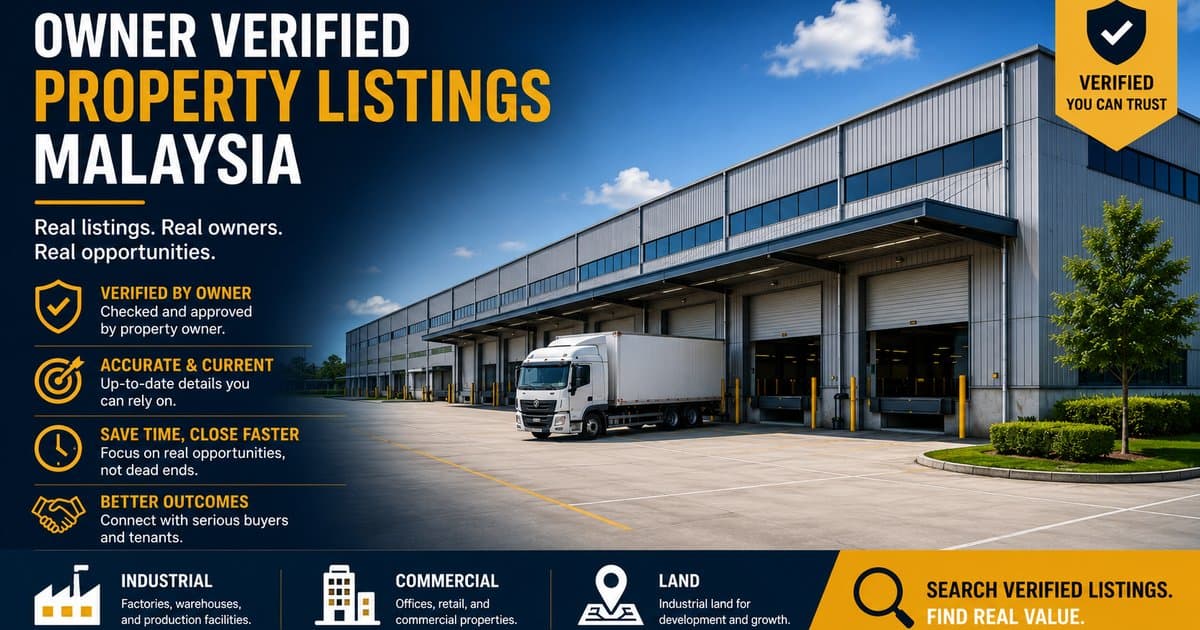
A warehouse inquiry looks promising until the caller learns the owner never approved the advertised price, the built-up is outdated, or the space was leased weeks ago. That is exactly why owner verified property listings Malaysia matter, especially for industrial, commercial, and land transactions where timing, accuracy, and decision speed affect real business outcomes.
For serious buyers, tenants, and investors, verification is not a marketing extra. It is a filter that reduces wasted calls, shortens screening time, and improves confidence before site visits or negotiations begin. In a market as active and fragmented as Malaysia, particularly across Selangor, Shah Alam, Port Klang, Subang Jaya, and other industrial corridors, that distinction can save weeks.
An owner verified listing generally means the listing has been checked against the property owner, or against a party directly authorized to market the asset. In practical terms, that usually covers the owner’s intent to sell or lease, the broad pricing position, the property type, and key asset details such as location, land area, built-up size, tenure, and sometimes zoning or usage profile.
That said, verification is not a universal standard. One platform may verify only that the owner exists and gave permission to advertise. Another may go further and confirm current availability, asking price, tenancy status, or whether an exclusive agent has been appointed. For industrial and commercial searches, that difference matters. A verified factory for sale with confirmed power supply, loading access, and occupancy status is far more useful than a listing that simply carries an owner-approved label.
The right approach is to treat owner verification as a strong first layer of trust, not the final layer of due diligence. It improves signal quality, but it does not replace document review, title checks, planning review, or site inspection.
Residential buyers can sometimes tolerate a bit of listing noise. Industrial occupiers, logistics operators, and land investors usually cannot. If you are sourcing a factory in Shah Alam, a warehouse in Port Klang[1], or industrial land in Selangor, every mismatch has a cost.
The first cost is speed. Site selection teams often work against lease expiry dates, production expansion timelines, or relocation schedules. A non-verified listing can create dead ends - unavailable stock, inflated size claims, or prices that no longer reflect the owner’s position. That slows down comparison and delays internal approval.
The second cost is market distortion. When the same property appears multiple times with different pricing, different sizes, or different brokers claiming different terms, buyers lose a clean view of market value. Owner verification helps tighten that gap. It does not eliminate negotiation spread, but it reduces obvious inconsistencies.
The third cost is operational fit. Industrial assets are not interchangeable. A warehouse may look suitable until you confirm loading configuration, ceiling height, power capacity, floor loading, road access for heavy vehicles, or whether the title and use align with your operation. Verified listings tend to start with stronger baseline accuracy, which makes early-stage filtering more reliable.
A verified badge or label should prompt better questions, not blind trust. The fastest-moving buyers usually review a listing with a transaction mindset. They want to know whether the property is real, current, and commercially usable.
Start with the basics. Check whether the asking price is clearly stated, whether the location is specific enough to support logistics or catchment analysis, and whether the land area or built-up is presented in a way that allows direct comparison. For industrial users, vague descriptions are a red flag. If the listing says "good warehouse" but omits power supply, access, eaves height, or tenure, verification alone does not make it decision-ready.
Then look at ownership relevance. Is the listing owner verified for direct owner marketing, or owner verified through an appointed intermediary? Both can be valid, but the process is different. Direct owner listings may move faster on factual clarification. Agent-managed verified listings may offer better coordination, especially for larger or more sensitive assets. It depends on the property and the seller’s preferred route to market.
Finally, test recency. A quality verified listing should not sit unchanged while market conditions move around it. If pricing is unusually attractive, ask when the verification was last refreshed and whether competing offers, tenancy changes, or revised owner instructions have emerged.
The strongest owner verified listings do not rely on the verified label alone. They present enough transactional detail for a serious inquiry.
For a factory for sale, that means the listing should ideally show location, tenure, land size, built-up, asking price, access conditions, and broad use suitability. For a warehouse for rent, users should expect rental guidance, loading format, floor profile, and logistics relevance. For industrial land, zoning cues, tenure, shape, frontage, infrastructure status, and development angle often matter as much as price.
This is where a specialized marketplace has an advantage over a general portal. When the platform is built around commercial and industrial search intent, the listing structure tends to reflect how occupiers and investors actually compare stock. XPillar, for example, is designed around categories and search patterns that matter in real transactions - not casual browsing.
Verification improves listing quality, but serious users should stay realistic about what it does not solve.
It does not confirm that the property is the best value in the submarket. Owners can still price aggressively. A verified listing in Subang Jaya may be fully legitimate and still sit above market if the owner is testing demand.
It does not guarantee legal or technical suitability. A verified industrial land listing may still require checks on title restrictions, conversion issues, utility readiness, access rights, environmental considerations, or development approvals.
It also does not remove negotiation complexity. In higher-value transactions, owners may shift expectations after receiving stronger-than-expected interest, or they may prioritize buyers with cleaner terms over headline price. Verification helps you reach the right party faster, but the deal still depends on structure, timing, and seriousness.
The most effective way to use owner verified listings is to treat them as a decision-shortening tool. Build a shortlist faster, but keep your underwriting discipline intact.
If you are an occupier, use verified listings to screen for operational fit first. Focus on transport connectivity, usable area, access conditions, and whether the property supports your production or storage model. If you are an investor, compare verified stock based on income potential, redevelopment angle, location resilience, and exit appeal. If you are acquiring land, prioritize title position, tenure, zoning alignment, and surrounding industrial momentum.
This also helps in negotiation. When listing details are clearer and owner-backed, you can spend less time arguing about basic facts and more time discussing terms, handover timing, conditionality, and pricing logic. That creates a more efficient process on both sides.
In Malaysia, asset competition is not evenly distributed. Verified listings carry more value in high-demand industrial belts where decision windows can be tight and comparable stock moves quickly. Selangor remains the clearest example, with sustained demand across manufacturing, logistics, warehousing, and last-mile distribution zones.
In these areas, the search challenge is rarely a lack of listings. It is sorting accurate opportunities from duplicated, stale, or loosely described inventory. That is why owner verification has become more relevant. It helps serious market participants focus on listings that are more likely to convert into real discussions.
For owners and landlords, the benefit is just as practical. Verified listings attract better-quality inquiries because the market reads them as more credible. That can reduce low-intent traffic and improve the chances of speaking with buyers or tenants who already understand the property profile.
A good listing should do more than generate clicks. It should move the right party one step closer to inspection, underwriting, and negotiation. In Malaysia’s industrial and commercial market, owner verification is one of the clearest ways to make that happen with less friction and better trust from the start.
