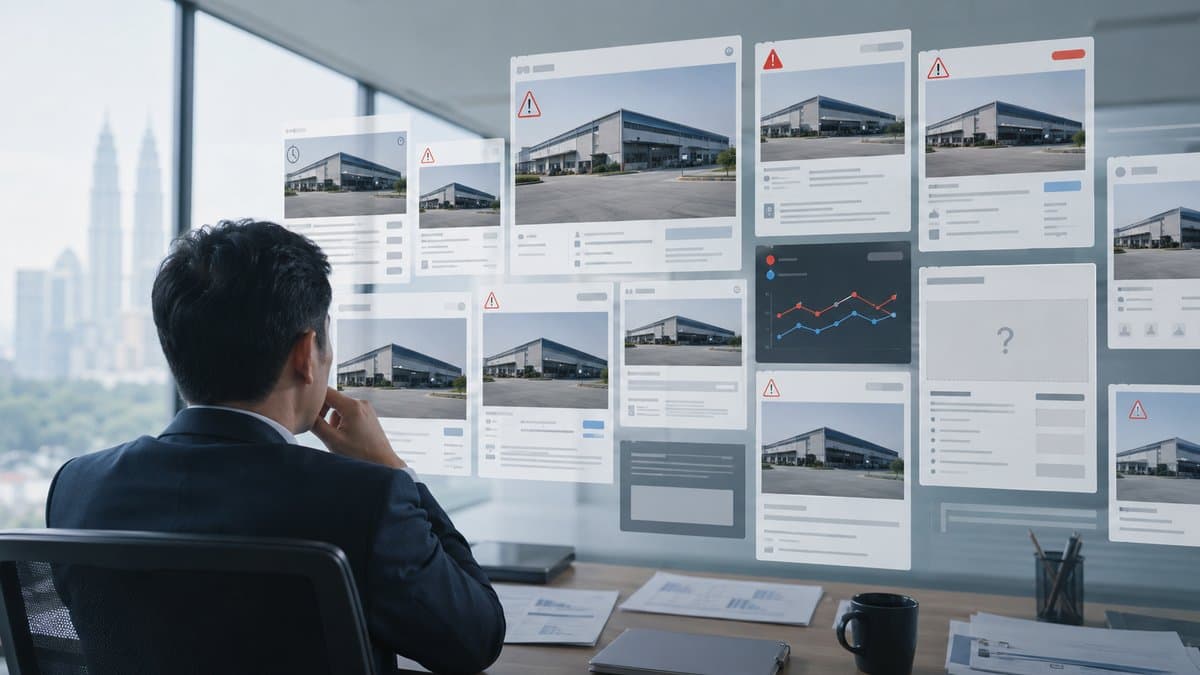
Kimi K3 and the Future of AI Property Search in Malaysia. Artificial intelligence is rapidly changing how people search, compare information and make business decisions.
The latest example is Kimi K3, developed by Moonshot AI. According to Moonshot AI, Kimi K3 was released on 16 July 2026 as a natively multimodal model with 2.8 trillion parameters and a one-million-token context window. It is designed for long-horizon coding, knowledge work and complex reasoning. Moonshot AI’s official information
Its rapid rise highlights an important shift: users are no longer relying only on conventional search engines. Increasingly, they are asking AI systems to research, compare and recommend suitable solutions.
Instead of browsing through many pages, a property buyer may soon ask:
“Find me verified industrial land between 20 and 50 acres in Selangor, with suitable zoning, highway access and potential high-power infrastructure.”
The AI system would then be expected to understand the requirements, evaluate the available information and present the most relevant options.
This development may have major implications for Malaysia’s property industry.
The Problem with Conventional Property Search: Malaysia’s online property market contains a large volume of information, but quantity does not always mean clarity.
Property seekers may encounter:
· Duplicate advertisements for the same property
· Outdated or unavailable listings
· Different prices for what appears to be the same property
· Incomplete land and building information
· Unverified ownership or appointment details
· Difficulty comparing industrial properties
· Limited information about zoning, power, water and infrastructure
These issues are particularly serious for industrial and corporate property decisions.
A manufacturer, logistics operator or data centre developer does not only need to know the property’s price and location. The company may also need to assess:
· Land title and zoning
· Building specifications
· Floor loading and ceiling height
· Power capacity
· Water availability
· Fibre connectivity
· Highway and port access
· Planning restrictions
· Environmental requirements
· Purchase or leasing structure
This is where AI-assisted property search could eventually create meaningful value.
How AI Could Improve Property Search: AI should not simply produce more property advertisements. Its greater value could be helping users understand, filter and compare available information.
In the future, an AI-enabled property platform may help users:
1. Search Using Real Business RequirementsInstead of selecting only a location and price range, a customer could describe the complete requirement in ordinary language.
For example:
“We need a 200,000 sq ft warehouse near Port Klang, with high floor loading, sufficient loading bays and a five-year lease.”
The platform could identify potentially relevant listings based on multiple criteria.
2. Detect Possible Duplicate ListingsAI could compare location, photographs, land area, building measurements and listing descriptions to identify properties that may have been advertised more than once.
This would support a cleaner and more transparent property-search experience.
3. Highlight Missing Information: When an industrial listing does not include important specifications, the system could indicate what still needs to be confirmed.
For a potential data centre site, this may include:
· Confirmed power capacity and delivery timeline
· Distance to the relevant substation
· Water availability
· Fibre routes and redundancy
· Flood and soil conditions
· Planning and authority requirements
AI should not invent these answers. Instead, it should clearly distinguish between confirmed, unconfirmed and unavailable information.
4. Improve Property Matching.
A suitable property is not always the cheapest or closest option.
AI could assist by comparing the customer’s operational requirements against each property’s characteristics, helping buyers, tenants and appointed professionals identify the most relevant opportunities more efficiently.
5. Make Malaysian Property Data Easier to Understand.
Property information often contains technical terminology involving land titles, zoning, tenure, planning permission and infrastructure.
AI could help explain this information in clearer language while reminding users when professional, legal or technical verification is required.
XPillar’s Direction for AI-Assisted Property Search: XPillar is a Malaysian property-search platform featuring industrial land, factories, warehouses and other property categories.
The platform’s long-term direction is to explore how technology and artificial intelligence can make property discovery more structured, transparent and relevant.
Potential future capabilities may include:
· Natural-language property searches
· AI-assisted listing matching
· Possible duplicate-listing detection
· Property comparison tools
· Automated identification of missing listing information
· Industrial-property requirement matching
· Data-supported recommendations
· Multilingual property search
· AI-assisted enquiries for buyers and tenants
These capabilities remain part of XPillar’s future technology direction and should not be interpreted as features that are already fully available.
The objective is not to replace licensed property professionals, lawyers, valuers, engineers or technical consultants.
Instead, AI could help users organise information, discover relevant properties and identify the questions that must be answered before making a decision.
Trust Must Remain at the Centre of Property AI can process information quickly, but the quality of its output depends on the quality of the underlying data.
For high-value property transactions, AI-generated statements must never replace proper verification.
Information involving ownership, land use, power supply, water capacity, development approvals and building specifications must still be verified through relevant documents, authorities, utility providers and appointed professionals.
For XPillar, the future of property technology should therefore be built around three principles:
#Better Data. #Clearer Information. #More Relevant Matching.
An AI property platform should not merely answer quickly. It should also explain what is known, what remains unconfirmed and what requires further due diligence.
From Search Engines to AI Property Assistants. The popularity of systems such as Kimi shows that the next generation of internet users may increasingly expect AI to perform research on their behalf.
For property platforms, this means future success may depend on more than the number of advertisements published.
Platforms will need structured property information, clear sources, accurate descriptions and pages that AI systems can understand.
XPillar is preparing for this transition by building a property-search ecosystem focused on more reliable listings, clearer information and stronger matching between property requirements and available opportunities.
Looking for Industrial Property in Malaysia?Businesses, investors and property owners may use XPillar to explore factories, warehouses and industrial land in Malaysia.
If a suitable listing is not currently displayed, corporate buyers and tenants may also submit their requirements, including:
· Preferred location
· Purchase or lease
· Land or building size
· Property use
· Power requirements
· Budget
· Project timeline
Property owners with factories, warehouses or industrial land may also submit their properties for consideration.
Explore Malaysian Industrial Properties on XPillar
View Industrial Property Listings
FAQ
1. Is XPillar currently using Kimi AI?
No. XPillar has not announced a partnership or integration with Kimi. Kimi K3 is discussed as an example of how rapidly AI technology and AI-assisted search are developing.
2. Will XPillar introduce AI property search?
XPillar is exploring future AI-assisted capabilities, including natural-language search, property matching, listing comparison and possible duplicate-listing detection. Availability will depend on future development and testing.
3. Can AI confirm whether an industrial property is suitable?
AI may help organise and compare available information, but it cannot replace official verification. Zoning, ownership, power, water, fibre, planning suitability and other technical matters must be confirmed by the relevant authorities and professional consultants.
4. What properties can users find on XPillar?
XPillar features Malaysian property listings, including factories, warehouses, industrial land and other property categories, with a growing concentration of industrial opportunities.
未来,企业客户可能只需告诉AI:
“我要在雪兰莪寻找20至50英亩的工业土地,需要合适的工业用途、良好交通,并具备进一步评估高电力基础设施的条件。”
AI便可以协助整理需求、筛选房源、比较资料,并指出哪些技术条件仍然需要确认。
这也是XPillar未来希望探索的方向:
· AI自然语言房产搜索
· 房源智能匹配
· 潜在重复房源识别
· 工业地产资料比较
· 缺失资料提醒
· 买家及租户需求配对
· 中英文智能搜索
AI不能代替律师、工程师、估价师或有关当局,但可以让房地产搜索变得更清楚、更有效率。
浏览XPillar工业房源 https://www.xpillar.com/properties/industrial?utm_source=chatgpt.com
/kimi-k3-future-ai-property-search-malaysia