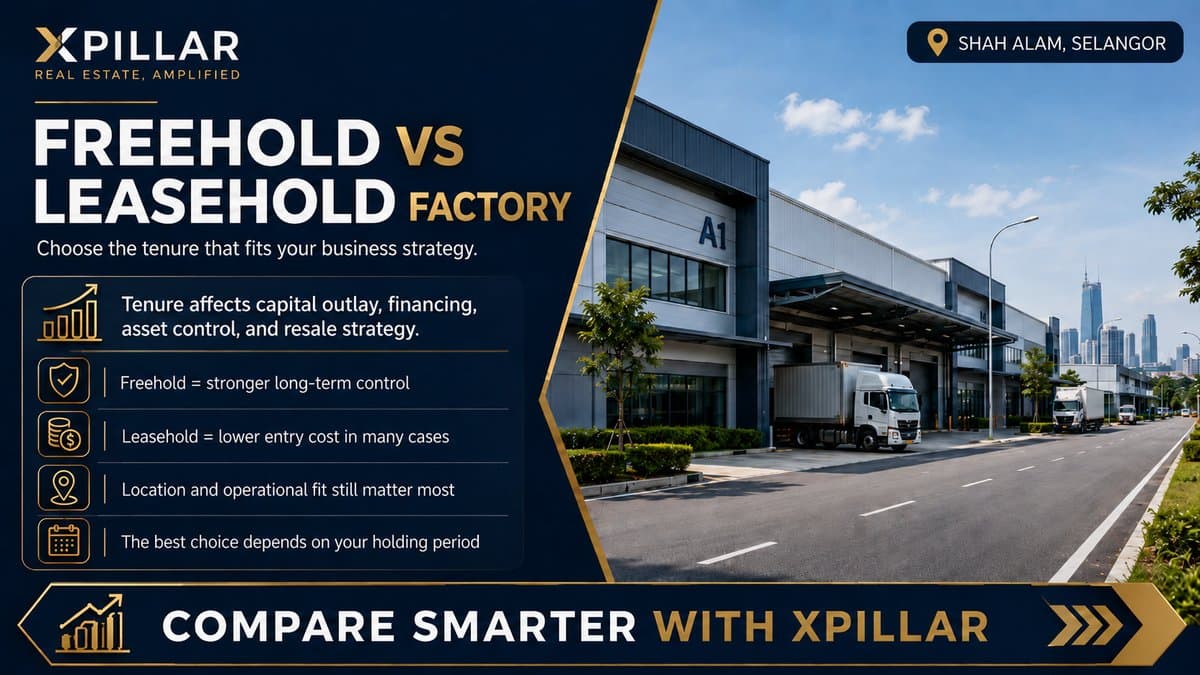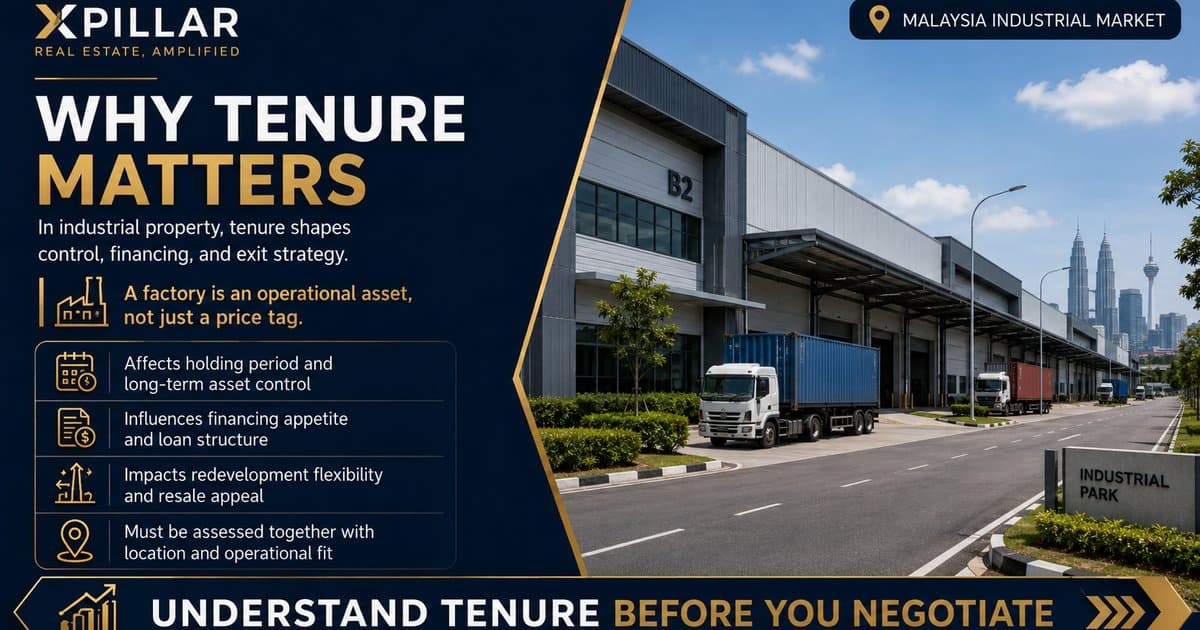
A factory in Shah Alam with the right power supply, loading access, and zoning can still be the wrong deal if the tenure does not match your business plan. That is why the freehold vs leasehold factory question matters early, not after price negotiations start. For investors, manufacturers, and logistics operators in Malaysia, tenure affects capital outlay, financing, asset control, redevelopment flexibility, and resale strategy.
In industrial property, tenure is not just a legal label. It shapes how long you can hold the asset, what you can do with it, and how the market is likely to price it over time. A buyer planning to operate for 20 years will assess tenure differently from a buyer targeting rental yield or a developer looking at land assembly.
A freehold factory generally gives the owner permanent ownership of the property, subject to land laws, title conditions, and authority requirements. In practical terms, it is the closest thing to long-term control over an industrial asset. This is why freehold stock in established corridors often attracts strong demand, especially where industrial land is limited.
A leasehold factory is held for a fixed term, often 30, 60, or 99 years depending on the title. Once the remaining tenure starts to shorten, buyer behavior changes. Financing can become more selective, resale pools may narrow, and the property may require a different pricing strategy compared with a similar freehold asset nearby.
That said, freehold is not automatically better in every case. The better choice depends on your holding period, cash flow model, financing profile, and location priorities.
Industrial assets are operational properties. A factory is not just bought for appreciation. It must support trucks, production flow, worker access, utility loads, storage ratio, and often licensing requirements. If the site works operationally, some buyers will accept leasehold because business continuity matters more than perpetual ownership.
At the same time, factories usually involve larger capital commitments than smaller commercial units. Buyers are looking at land area, built-up size, ceiling height, power supply, expansion potential, and compliance risk. Tenure becomes part of that larger investment equation because it affects both usage and exit.
For example, a logistics operator may prefer a strategically located leasehold factory in Port Klang over a freehold factory in a weaker distribution corridor. A long-term manufacturer with a specialized fit-out may lean toward freehold because relocation costs are high and future redevelopment flexibility matters.
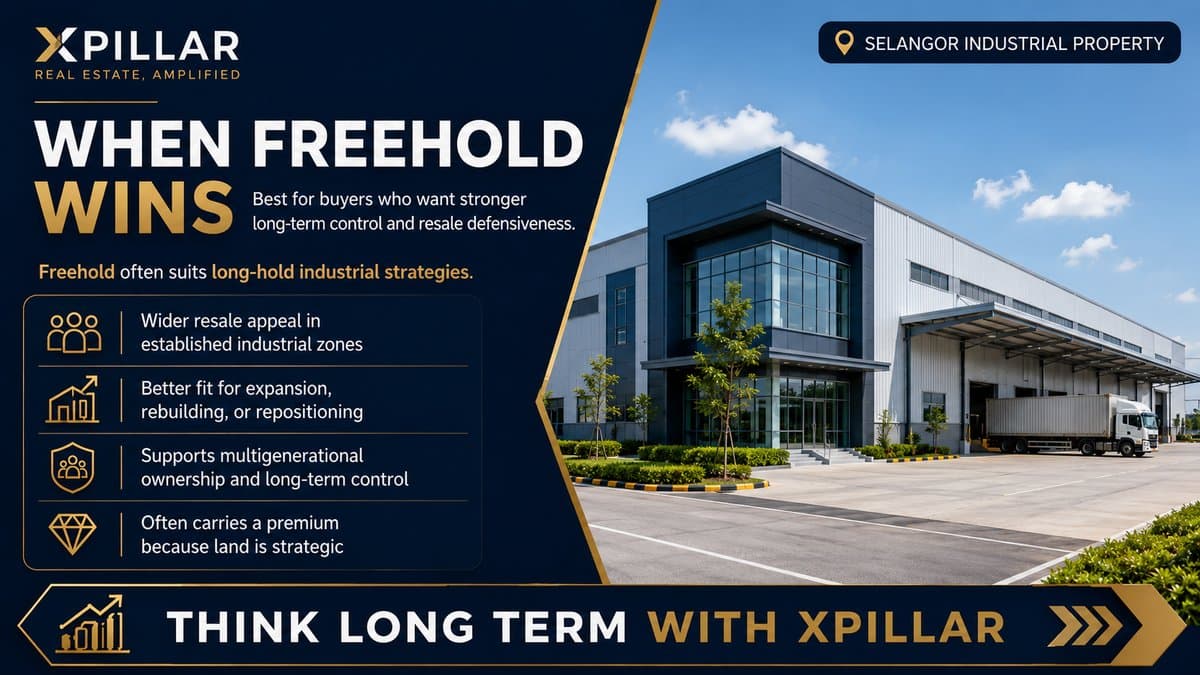
A freehold factory usually suits buyers who want long-term balance sheet strength and control. Investors often favor freehold because it tends to hold wider market appeal at resale, especially in established industrial zones across Selangor and the Klang Valley. There is also a psychological premium in the market. Many buyers simply feel more secure owning an industrial asset without a ticking tenure clock.
Freehold can be especially attractive when the land itself carries strategic value. In mature industrial pockets where available stock is limited, the land component may become a key driver of future pricing. This matters for owner-occupiers who may want to expand, rebuild, or reposition the site later.
Another advantage is planning flexibility over a longer horizon. If your business expects phased expansion, a freehold site can support that strategy better than a leasehold property with a shorter remaining term. It also tends to fit multigenerational business ownership or long-hold industrial portfolio strategies.
The trade-off is straightforward. Freehold factories often come with higher asking prices. In prime locations, that premium can be significant, and the higher capital outlay may reduce immediate yield if you are buying for income.
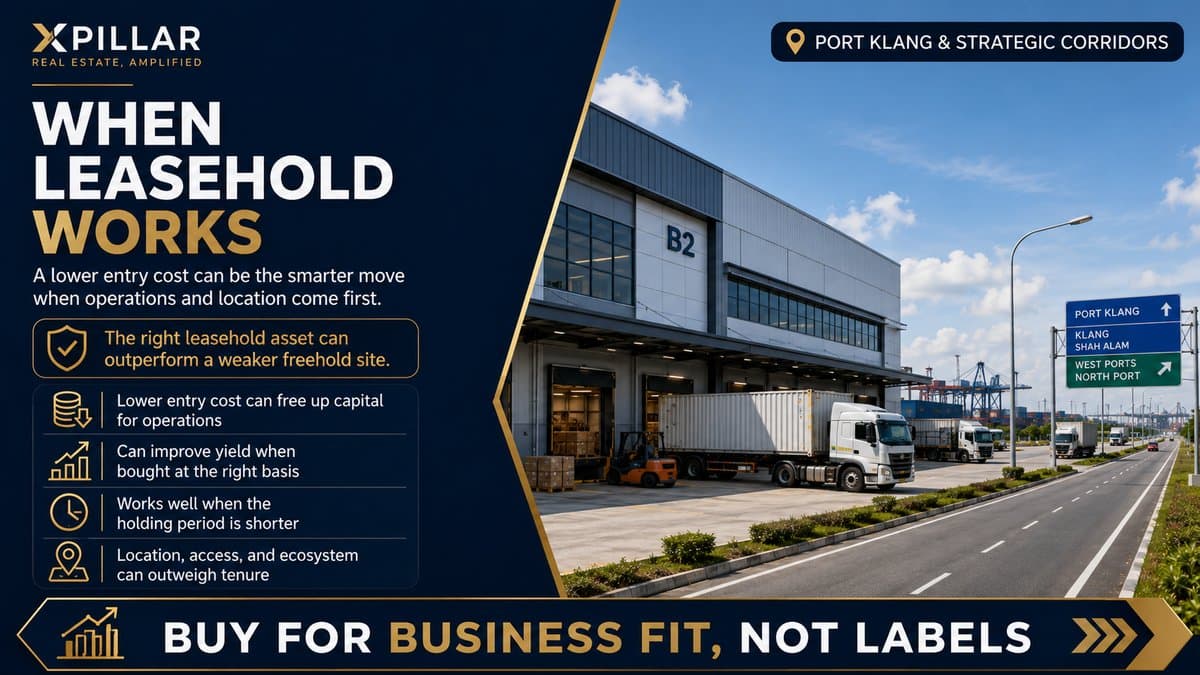
A leasehold factory can be the more efficient choice when location and operating performance matter more than perpetual ownership. In many industrial areas, leasehold stock is priced more competitively, which lowers entry cost and may improve returns if the asset is acquired well.
For owner-occupiers, that lower acquisition cost can free up capital for machinery, automation, racking systems, cold-room installation, or working capital. For investors, it can create stronger rental yield on day one if the purchase price is sufficiently discounted against comparable freehold stock.
Leasehold also makes sense when your expected holding period is shorter than the remaining tenure issue horizon. If you plan to hold the factory for seven to 12 years and the property still has a healthy remaining term, the practical impact may be limited, provided financing and resale demand remain reasonable.
This is often the case in strong industrial corridors where occupier demand is driven by access to ports, highways, labor catchment, and ecosystem clustering. A well-located leasehold factory with the right specifications can outperform a poorly located freehold property from a business-use perspective.
In a freehold vs leasehold factory comparison, price alone is not enough. You need to assess total capital efficiency. A freehold property may cost more upfront but preserve value better over time. A leasehold property may offer a lower entry point and stronger income yield but require sharper attention to tenure decay and refinancing conditions.
Banks also look at tenure. While lending policies vary, shorter remaining lease terms can affect loan margin, loan tenure, and approval appetite. That matters for investors leveraging multiple assets and for businesses trying to preserve borrowing capacity for operations.
Cash flow analysis should include more than mortgage cost. Look at maintenance, reinstatement needs, compliance upgrades, land area efficiency, and whether the site supports future revenue growth. If a leasehold factory allows you to secure a superior logistics location at a lower purchase price, the operational gain may outweigh the tenure discount.
Exit matters from day one. A freehold factory generally appeals to a broader mix of buyers, including owner-occupiers, long-hold investors, and land-focused purchasers. That wider audience can support resale value, particularly in proven industrial markets.
Leasehold resale depends heavily on remaining term, property condition, and local demand depth. A leasehold factory with 80-plus years remaining in a high-demand corridor is a very different proposition from one with a much shorter balance term in a secondary location. Buyers and banks will not price them the same way.
If your strategy depends on easy disposal later, freehold often provides more room for error. If your strategy is yield-focused and you buy leasehold at the right basis, the exit can still be attractive, but you need disciplined acquisition pricing.
Industrial property is still location-driven. In Malaysia, a factory close to Port Klang, Northport, Westport, Subang logistics routes, or major expressways can carry stronger occupier demand regardless of whether it is freehold or leasehold. Access, infrastructure, and industrial ecosystem often have a bigger effect on rentability than tenure alone.
This is where serious buyers need to avoid oversimplifying the decision. A freehold factory in a weaker industrial pocket may look safer on paper but underperform in tenant demand, transport efficiency, or future occupier interest. A leasehold factory in a prime manufacturing or logistics corridor may generate stronger business value from day one.
The right approach is to assess tenure together with zoning, title restrictions, built-up specifications, loading design, power supply, and traffic flow. Tenure is one decision factor, not the only one.
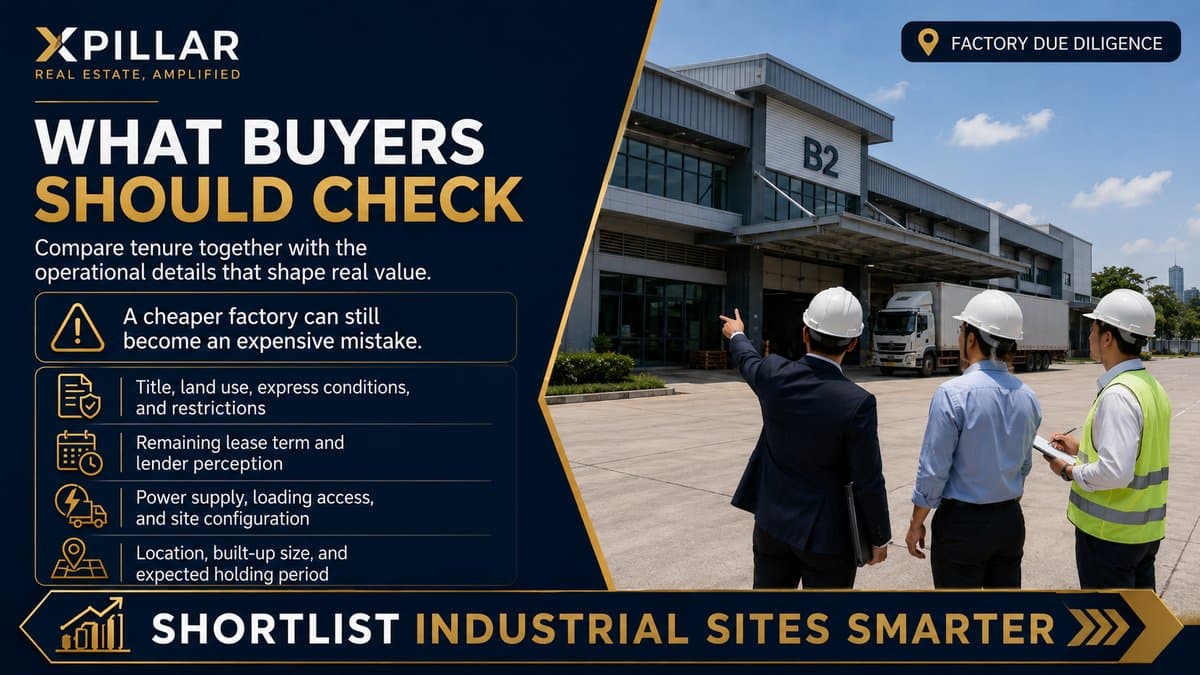
When reviewing any factory for sale, confirm the title details early. Freehold status does not remove the need to check land use, category of land use, express conditions, restrictions in interest, and whether the built form aligns with approvals. Leasehold assets require an extra layer of review around remaining term, renewability assumptions, and how future buyers or lenders are likely to view the asset.
You should also evaluate whether the existing factory configuration actually supports your use case. A lower-priced leasehold asset can become expensive if it needs major upgrading to meet loading, production, or warehouse requirements. The same is true for an older freehold factory with obsolete layout or insufficient power.
For buyers screening multiple industrial listings, structured comparison helps. Compare tenure together with location, lot size, built-up size, ceiling height, power capacity, dock access, asking price, and expected holding period. On platforms such as XPillar, this kind of side-by-side evaluation is often what separates a fast shortlist from a costly misstep.
If you are buying for long-term control, future redevelopment, or stronger resale defensiveness, freehold usually has the edge. If you are buying for operational efficiency, lower entry cost, or near-term yield in a strategic corridor, leasehold may be the better business decision.
The best factory is not always the one with the strongest tenure label. It is the one where tenure, price, location, and use case line up cleanly. Start there, and the shortlist becomes much easier to trust.