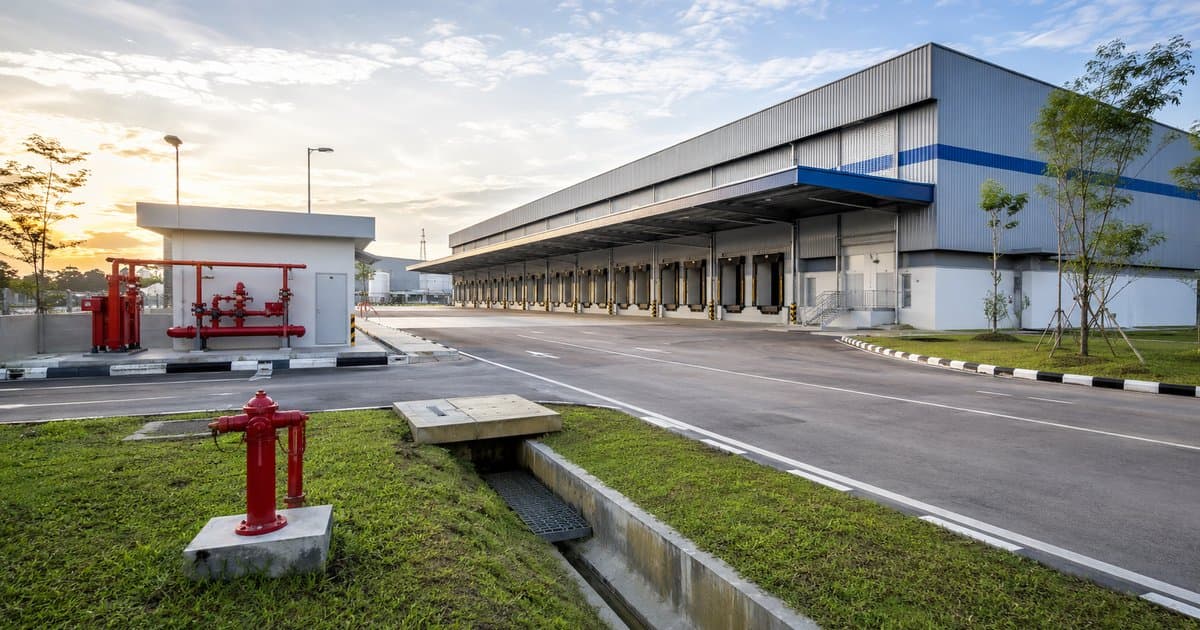
The short answer: before buying or renting a factory or warehouse in Malaysia, verify more than the CCC and portable fire extinguishers. Establish the building’s approved use and fire-safety design, whether it is a “designated premises” requiring a current BOMBA Fire Certificate, whether the installed systems match the approved plans, whether inspections and maintenance are current, and whether your proposed goods, racking, production process and fit-out will change the fire risk or approval requirements. Until qualified professionals and the relevant authorities have checked the actual premises and intended use, do not treat “BOMBA compliant” as a verified property feature.
Fire compliance is both a life-safety issue and a transaction risk. Defects can delay occupation, business licensing, insurance acceptance or tenant fit-out. A change from light storage to high-piled combustible stock, or from general manufacturing to a hazardous process, may materially affect the required protection even when the building itself has not changed.
The correct approach is to compare three things: what was approved, what is installed and maintained today, and what the incoming occupier intends to do.
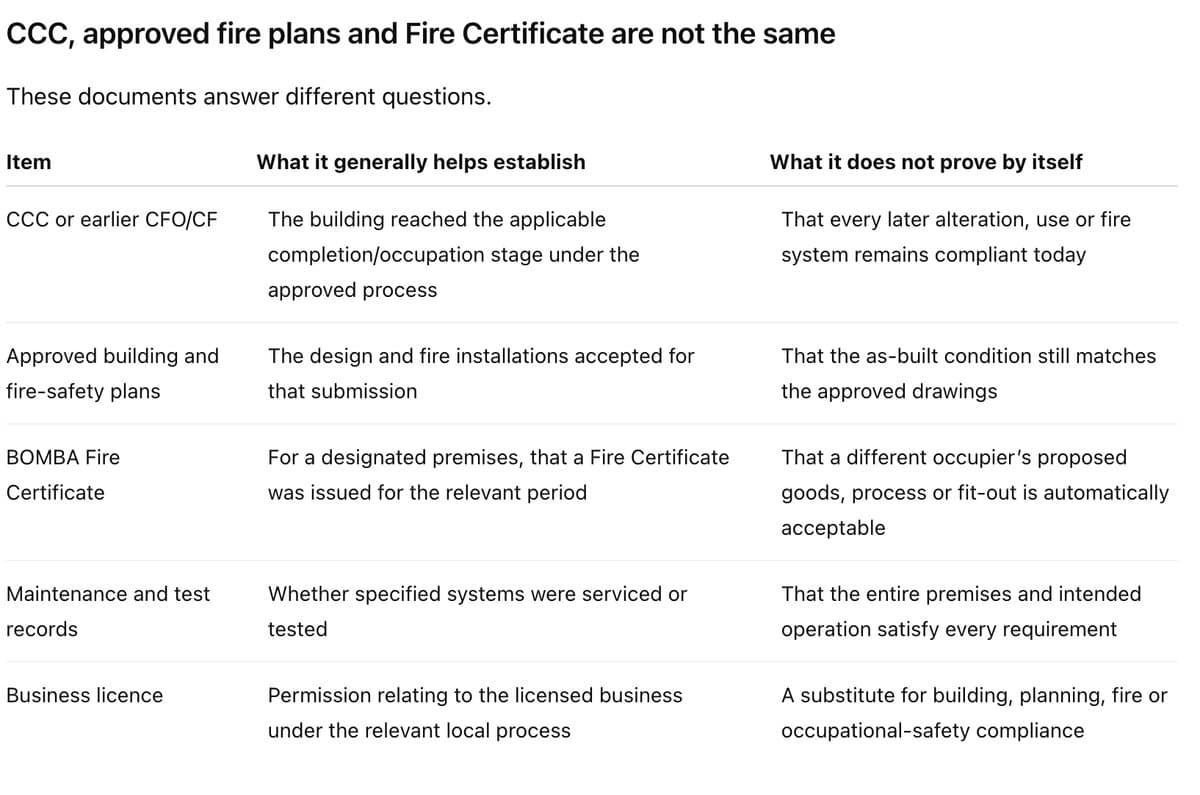
No. A Fire Certificate is required for premises that fall within the legally defined designated premises categories. Factories and “storage and general” premises are included when the relevant size, storey, volume, sprinkler or special-process criteria are met.
Because the thresholds depend on the exact building and use, check the current official schedule rather than relying on a simplified statement from an agent or owner. JBPM publishes a current Fire Certificate overview and designated-premises table. The underlying statutory framework is the Fire Services (Designated Premises) Order 1998, reprinted as at 1 April 2023 and incorporating the 2020 amendment.
JBPM states that all designated premises must have a Fire Certificate, and its public guidance states that the certificate is valid for 12 months. New designated premises should apply after obtaining the applicable CCC, CFO or CF. The status, expiry date and premises details should therefore be checked—not assumed.
For a building outside the designated-premises thresholds, fire-safety laws, approved building requirements, local licensing conditions and workplace duties can still apply. “No Fire Certificate required” does not mean “no fire-compliance obligations.”
##Start with the incoming operationBefore inspecting the property, prepare an operation brief covering:
- manufacturing process or storage activity;
- commodity type and combustibility;
- hazardous, flammable or scheduled materials;
- pallet, carton, plastic or packaging content;
- maximum storage and racking height;
- floor and mezzanine layout;
- number of workers and shift pattern;
- hot work, charging, fuel or gas use;
- cold-room or insulated-panel construction;
- machinery, ovens or heat-producing equipment;
- proposed partitions, offices and production rooms; and
- expected future expansion.
The same warehouse shell can present very different risks when used for metal components, paper products, tyres, chemicals, batteries or high-piled plastic goods. A consultant cannot assess suitability accurately without knowing the proposed operation.
##Ten checks before buying or leasing
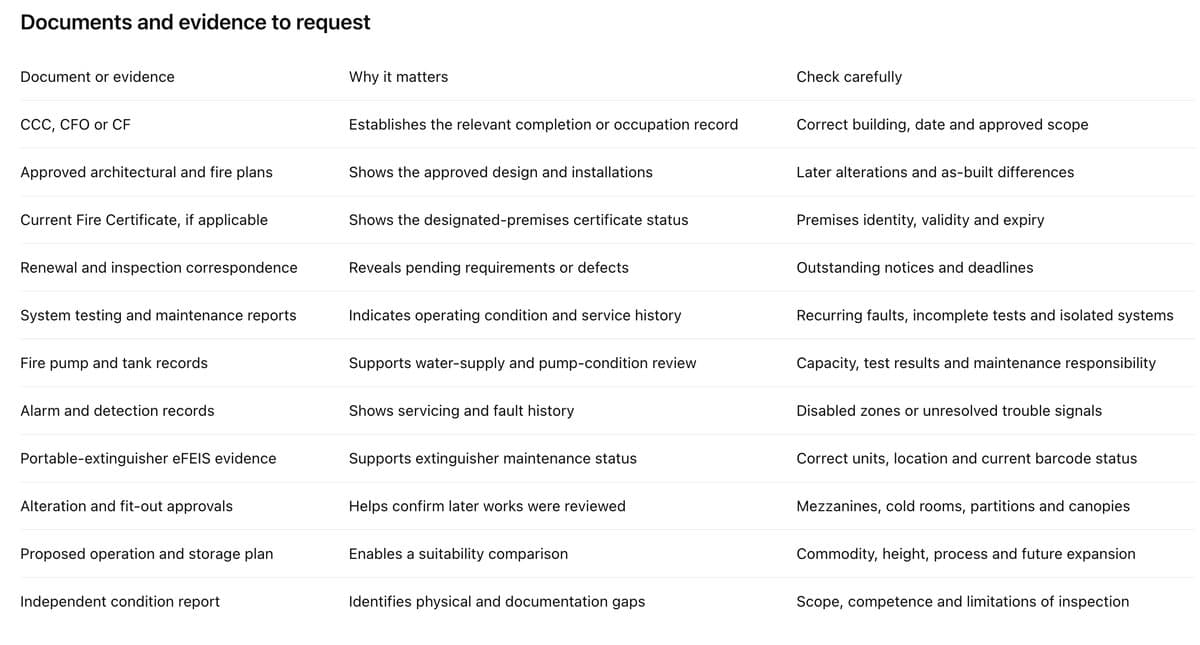
1. Confirm the approved use and plan historyObtain the CCC/CFO/CF, approved architectural plans, approved fire-safety plans and later alteration approvals. Confirm that the building is approved as the type of industrial premises being offered and that additions, mezzanines, partitions, canopies and office areas appear in the approved record where required.
Do not assume a physically completed structure is approved merely because it has existed for years. Compare the plans with an on-site survey.
2. Determine whether it is a designated premisesAsk the owner for the basis used to determine Fire Certificate status. If the premises meets a designated category, request the current certificate, previous certificates, renewal submissions, inspection correspondence and any outstanding notices.
Check that the certificate refers to the correct premises, building and period. If the status is unclear, obtain confirmation through the relevant JBPM process or appointed professional. JBPM’s ePREMIS platform includes modules for first-time, renewal, new, amended and replacement Fire Certificate applications.
3. Compare installed systems with approved drawingsA qualified inspection should identify the fire-safety installations required and actually present, which may include:
sprinkler or other suppression systems;
hose reels and hydrants;
- fire pumps, water tanks and associated valves;
- alarm, detector and control-panel systems;
- emergency lighting and exit signs;
- smoke-control or ventilation systems;
- fire doors, shutters and compartmentation;
- protected staircases and escape routes;
- fireman access and appliance circulation; and
- portable fire extinguishers.
Missing heads, relocated walls, obstructed hose reels or unapproved openings can undermine an otherwise complete system.
4. Review inspection, testing and maintenance evidenceRequest current and historical service reports, test results, defect lists and rectification records. Look for recurring pump faults, isolated zones, closed valves, alarm trouble signals, damaged doors, expired components and systems placed out of service.
Portable extinguishers are only one part of the review. JBPM’s eFEIS programme manages portable-extinguisher maintenance and inspection under the stated Malaysian standard, using registered competent persons and contractors. A current extinguisher barcode does not validate sprinklers, alarms, pumps, exits or the overall building condition.
5. Check water supply, tanks and fire pumpsEstablish the fire-water source, storage capacity, pump arrangement, maintenance responsibility and access. Review test records and verify whether later building expansion has changed the protected demand or system coverage.
Visible tanks and red pipework are not proof of adequate performance. Testing and hydraulic or design review should be carried out by appropriately qualified parties for the actual risk.
6. Inspect exits, travel paths and compartmentationCheck that escape routes, staircases, exit doors and discharge paths are usable and not blocked by stock, racking, machinery or security installations. Review fire-rated walls, floors, doors, shutters, service penetrations and compartment boundaries.
An unlocked exit door is not enough if the route leads through an obstructed loading area or a later partition has increased travel distance. The incoming layout must be assessed before fit-out.
7. Match sprinklers to storage and rackingWarehouse protection depends on more than whether sprinklers exist. Commodity type, packaging, storage height, rack configuration, aisle arrangement, roof height and clearance below sprinklers can affect the design basis.
Adding taller racks, solid shelving or different goods may change the hazard. Do not copy the previous tenant’s arrangement without a fire-protection assessment. The lease should make clear who pays for redesign, in-rack protection or related upgrades.
8. Investigate alterations and tenant fit-outIdentify all additions made after the original approval: mezzanines, production rooms, cold rooms, battery-charging rooms, ceiling systems, canopies, office partitions and external structures. Ask for approvals, drawings and completion records.
Malaysia’s building by-laws are gazetted and enforced at state level. KPKT/JKT explains that the national Uniform Building By-Laws document is a model reference and that the respective state by-laws carry enforcement effect. Use the version applicable to the property’s state and local authority. (JKT state UBBL resources)
9. Check fire-appliance access and external conditionsInspect perimeter access, hydrants, gates, road width, turning areas, loading congestion and any structures that obstruct emergency access. A warehouse can have an acceptable internal system but weak external access because containers, parked trailers or new guardhouse works occupy the intended route.
Visit during actual operating hours, not only when the yard is empty.
10. Allocate upgrade risk in the transactionBefore signing an unconditional sale agreement or tenancy, identify:
- who must obtain or renew the Fire Certificate;
- who pays for inspections and rectification;
- whether the owner consents to submissions and physical works;
- ownership of installed systems after lease expiry;
- access for testing and maintenance;
- responsibility for false alarms and system impairment;
- reinstatement obligations;
- conditions precedent for occupation or business licensing; and
- rights if approvals cannot be obtained by the required date.
The parties’ lawyers should draft the final terms. Marketing statements should not replace contractual warranties or due-diligence conditions.
Exercise caution when:
- “BOMBA approved” appears only in the advertisement;
- the owner cannot produce the approved fire plans;
- a Fire Certificate is expired or refers to another premises;
- the alarm panel shows faults or isolated zones;
- sprinkler valves are locked shut or inaccessible;
- pumps, tanks or hydrants have no recent test records;
- exits, hose reels or fire doors are obstructed;
- unapproved mezzanines or partitions are visible;
- racking reaches too close to sprinklers without design evidence;
- the proposed operation is more hazardous than the previous use;
- the tenant must occupy before assessment and rectification can finish; or
- responsibility for upgrades is left for “later discussion.”
The safest listing language is: “Fire-safety information stated by owner and subject to document review, professional inspection, intended-use assessment and relevant authority requirements.”
1. Define the intended activity, stock, process and layout.
2. Obtain the building, fire-plan and certificate records.
3. Determine designated-premises status for the actual building and use.
4. Compare approved plans with the physical premises.
5. Commission a qualified fire-safety inspection.
6. Review maintenance, testing, defects and outstanding notices.
7. Test the proposed racking, fit-out and operation against the existing design.
8. Price and programme required rectification or upgrades.
9. Confirm authority submissions and business-licence dependencies.
10. Put unresolved conditions, costs and responsibilities into the transaction documents.
For a broader acquisition review, see XPillar’s Factories for Sale: What Smart Buyers Check and Factory Power Supply in Malaysia.
Not by itself. A CCC relates to the approved completion process at a point in time. Later alterations, maintenance failures, changes of use, new racking, different goods or an expired Fire Certificate can create separate issues. Review the approved plans, present condition and intended operation.
- Does every factory and warehouse need a Fire Certificate?No. Fire Certificates apply to legally defined designated premises based on factors such as use, size, storeys, volume, sprinkler provision or special processes. Check the current JBPM table and obtain advice for the exact building. Other fire-safety duties may still apply even if a Fire Certificate is not required.
JBPM’s public Fire Certificate guidance states that a Fire Certificate for a designated premises is valid for 12 months. Check the certificate’s actual expiry date and whether renewal requirements or notices remain outstanding.
No. Portable extinguishers are only one component. Depending on the premises and approved design, sprinklers, pumps, tanks, alarms, detectors, hose reels, hydrants, fire doors, compartmentation, emergency lighting, exits and fire-appliance access may also require inspection and maintenance.
Not automatically. The incoming commodity, packaging, storage height, rack layout and production process may differ from the previous risk. A qualified professional should compare the proposed use with the system’s approved design and actual capability.
It depends on the property condition, proposed tenant fit-out and negotiated terms. The offer and lease should clearly allocate inspection, approval, rectification, system upgrade, maintenance, reinstatement and delay risk. Obtain legal and technical advice before signing.
ConclusionFactory and warehouse fire compliance cannot be verified by one certificate, one site photograph or the presence of red pipes. The defensible process connects the building’s approved design, its current physical and maintenance condition, its Fire Certificate status where applicable, and the incoming occupier’s actual risk.
Browse industrial properties on XPillar and state your intended use, storage profile, racking height, floor area and occupation date. Clear operational information helps XPillar and the appointed professionals identify the right questions before you commit.
This article provides general industrial-property information only. It is not fire-engineering, architectural, legal, insurance, occupational-safety or regulatory advice. Requirements vary by building, state, local authority, use and design. Engage appropriately qualified professionals and obtain written confirmation from the relevant authorities for the specific premises and proposed operation.
Authoritative sourcesAttorney General’s Chambers — Fire Services Act 1988 (Act 341)
Attorney General’s Chambers — Fire Services (Designated Premises) Order 1998, reprint as at 1 April 2023
JBPM — Fire Certificate overview and designated-premises table
JBPM — ePREMIS fire-safety and Fire Certificate modules
JBPM — eFEIS portable fire-extinguisher inspection system
JKT/KPKT — State-gazetted Uniform Building By-Laws resources
JKT/KPKT — Explanation of the Uniform Building By-Laws model reference
Factory Power Supply in Malaysiahttps://www.xpillar.com/news/factory-power-supply-in-malaysia-what-buyers-must-verify-before-buying-or-renting
industrial properties on XPillar
https://www.xpillar.com/properties/industrial
